Thursday, 11 November 2010

The Doll's Birthday


Today.
It seems she is really comfortable in the window and, since it's her birthday, I just thought to warm things up a bit.

Friday, 5 November 2010

Vampires Suck. Not all of them, though.

I have always been into vampires.

One of my "biggest regrets" is not having written a story that I had in mind when I was in primary school: it was about a vampire girl, aged 12, who didn't want to kill humans and then falls in love with one of them. Impossible love, of course. This made me jealous of every successful novel or movie that came out afterwards, from Interview with the Vampire (1994) to bloody Twilight (2008) and, finally, arriving to Let The Right One In.
Oh well...you can't patent ideas, can you?

The release of the American remake Let Me In by much respected director Matt Reeves, prompted me to watch the original Swedish movie, Låt den rätte komma in. 

I said I am into vampires, not horror movies. Therefore the immortal Christopher Lee and Murnau's Nosferatu are not included in the list. Hail to them, but no, thanks. Perhaps Gary Oldman's Dracula can still make it despite his various metamorphosis in furry wolf, giant bat, rats, old man, hot prince...
My ideal of vampire is, unfortunately, the Hollywood type: painfully beautiful, cold eyes, trickle of blood nobly falling from the corner of his mouth. Who, woman or man, wouldn't offer the neck to Brad Pitt? I bet Kirsten Dunst has a framed giant poster of this picture in her house.

Right, end of digressions.
Let The Right One In is very, very, very Ingmar Bergman: the silence; the suspended atmosphere telling us about a country where life goes on slowly, beaten by rigid seasons; the almost inquiring videocamera, closing up on the characters' soul. Real life is brilliantly painted in the movie and...oh, all of a sudden there is a vampire in the picture. It's a bit clashy, but nonetheless works.
Said vampire has no problem whatsoever in killing people and sucking their blood, to live. And the protagonist, Oskar, seems to have no problem with it either. A bit creepy there, I must say.

I was expecting someone to die. To turn into ashes. At least to get charged with murder, in the usually cathartic plot: the heroes win, the villains pay. Even if the villain is the hero.
Instead, the end - spoilers alert! - sees the two protagonists leaving the town together, with the boy ideally becoming the vampire's new guardian and partner (in crime). No issues about growing up apart, immortality vs mortality, etcetera. Quite a hasty, naive ending, and a shame, as it leaves too much space for imagination and a very worrying idea about rough justice: are you bullied at school like Oskar? Hit them harder, or befriend a vampire to have the thugs tore to pieces, why not.
This last bit, of course, adds a bit of implausibility to the whole situation, but the message is still clear: don't trust the system, do it yourself.

What happened to redemption? Lessons learned? Education?
I might sound like an old auntie or the preacher here, but movies are the reflection of real life, a mirror of what might happen. All of a sudden, movies are full of vigilantes administering their own justice.
And we sympathise with them, but maintaining at the same time our own judgment criteria.
I hope.

I would like to remember the vampire like this. A being torn between good and evil, that eventually pays or disappears. Every vampire movie teaches: you don't want to mess with the immortals.

Little note: I haven't read the book. Perhaps I should.

Saturday, 30 October 2010

A Change of Perspective: Valentino Diego and his Alterations


When I spoke about connections, I had no idea how far this would take me in terms of artists' contacts and all the great projects that have followed. 

Ladies and Gentlemen, I give you D.V., aka Valentino Diego. A post from very long time ago gave an introduction to our MA Curating the Contemporary brand new, self managed, not credited and auto funded Window Project, affectionately nicknamed the MACC Relay.
The first of four projects opened on 13 October, in the middle of one of the craziest weeks for London's contemporary art scene - and for SybinQ Art Projects in particular - ever. 
I already knew Diego's great capability to build things. Still, I had no idea about his incredible visual talent, nor about his photographic memory. Working with him made me rediscover another notion that is not really attached to contemporary artists anymore since a very long time: being able to craft things, to create new objects with your hands, to bend the medium and give it a different meaning. 
In one word: craftsmanship.


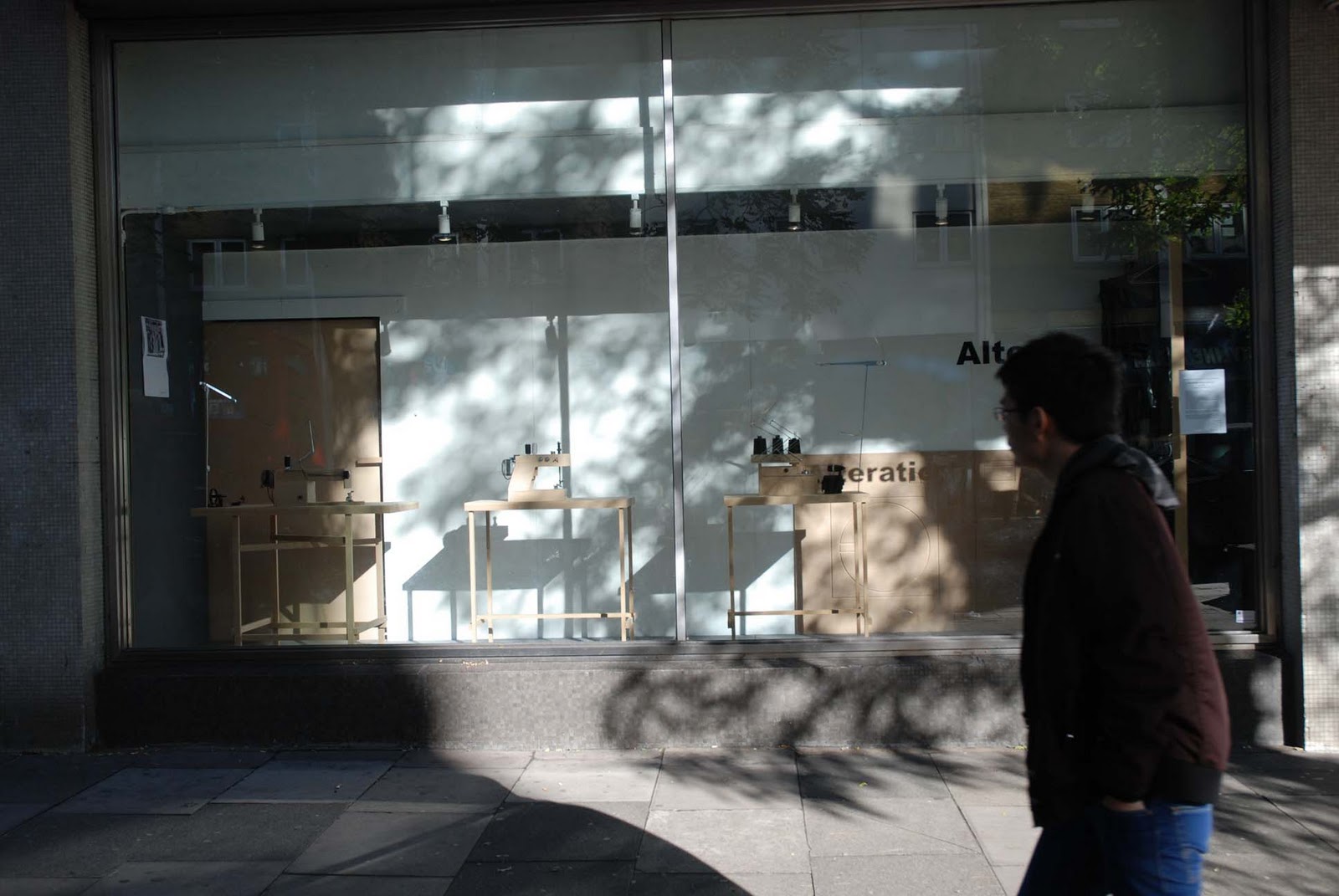
Diego took plain MDF, some metallic bits and pieces, hangers, bin bags and transformed everything into an environment, a place with functioning objects in it. This function was given by the idea behind the installation: a fake alteration shop, a prop, trying to convince the passer-by of its authenticity. 
In the text I wrote for the display panel, I came up with the concept of the street window being the primary form of display: we look at these windows expectantly, because we're used to them offering us something we may - or may not - desire.

Once again, the intention here is to stop this process.
Every single object on display seems to shout Just stop, look at me, look at me closely, I am not what you assume I am. Don't assume: experience it. 

Yesterday it was de-installation day, and all these beautiful objects came back to be waste material. While I was carrying everything out of the space and stacking them in a safe place (I don't have the heart to just throw everything away, as the artist instructed me), I couldn't help to think: all this work, and none of this made to last. 


On my way back to the underground, I noticed a huge advertising board at London Met, made to cover the current works in progress to refurbish the studios. It reads: "See things from a different perspective".

What a coincidence.

The Viewing Cabinet: Silvia Iorio strikes again

Oh yes, she does.

Perhaps you remember this post and all its implication of difficulties in the organisation of The Bay Window Project's sixth show. I'd like to throw myself in the account of what can be rechristen as The Chronicles of Silvia, but I have just realised that this whole blog is all about the organisational part of being a curator, whereas I want now to delve more into art theory...OK, maybe just one bit or two, because I think I can see you rolling your eyes in front of the screen.

Let me just tell you, then, that the pictures you see below were taken at the opening (by Fabio-God-Bless-Him-Lattanzi Antinori) and the artist arrived from Berlin, by bus, on the morning of the very same day (she doesn't fly. Even if she had a solo show in New York, she would go there by boat). Want to know what happened the day before? After having successfully delivered the work for The Bay Window, whose great impact and delightful humour I am going to describe in a minute, poor Silvia had to cross Berlin in all its length to get the essential UV lamp because I, the undersigned, was way too busy with another show to search for it in London and, moreover, couldn't find any in the few electrical shops I managed to go to.


SMS exchange on 13 October around 3 pm, with Silvia's Bus scheduled at 6:30 pm:

Si: My friend lost the dog,I had to take bus,no ticket,escaped the fine,have to prepare suitcase,retrieve my work from gallery and return house keys.CAN'T DO LAMP!

sy: Really Sorry.Can't do lamp either.They don't have it here! :( YOU HAVE to get it. No lamp,no party.

> Learning to say NO: Curator's Stuff

Against all odds, Silvia and the lamp were on the bus on time and the day after she triumphantly assembled everything in the window with the help of good Maddalena, transforming it in a glowing cabinet of modern prints.


As her subjects, she has chosen Museums: the place where most of the artists aspire to enter, sooner or later. The institution, the place that recognizes someone's efforts and, as she puts it, sanctions his or her contribution to the History of Art.
"Are you really interested in making history?" I once asked her.
"Indeed", was the reply.

Every building's picture was turned into an etching, in a dialogue between past and contemporary techniques of reproduction. I was mystified by the quantity (and shapes!) of Museums she managed to track down from all over the world. Some are pretty recognisable, some others...aren't. This prompted us to think about organising a competition on Facebook, coming soon.
Guess the Museum in Silvia Iorio's Viewing Cabinet: name and location.
After all, being familiar with most of the institutions around the world it's not only curator's, but also artist's, stuff.

Silvia Iorio entered every single Museum, virtually speaking, and stares at the viewer through a binocular. The viewer, in turn, needs the binocular to look at the installation properly, otherwise, what would be perceived as an effort to make something private public, is turned into private again. As the background for each museum, she chose the universe, a space nebula with stars and cloudy explosions of molecular mass, in her undying homage to Chaos and Chance. The UV lamp makes the whites glow, transporting everything in a surreal dimension; there is, indeed, much of the Surrealism inheritance in this work: Magritte immediately jumps to mind but, at the same time, you do realise that the way in which Silvia Iorio works is totally original, her own, and unexplored.

This work is an invitation to explore. The Universe of art, why not, but in the first place to explore a private window offering a cabinet of prints, curiosities, where the display itself almost institutionalises everything, transforming the space in a sort of Museum.


As you already know, not many people come to The Bay Window openings: we are not a gallery, we do not offer alcohol, we don't have an indoor space and this compels people to stand outside in the - now - cold evenings. English people very rarely come. Nonetheless, I was very pleased to see the small group who came to see this one: artists, curators and press editors.
All friends, all Italians. It was like being home for a while.

Tuesday, 26 October 2010

The Bay Window Project: Alice Anderson


THE BAY WINDOW PROJECT
Six Artists in a Frame


curated by sybin


NEXT OPENING: Tuesday 9 November at 6:30 pm. The artist will attend.
                                 Until Sunday 5 December.


SybinQ Art Projects
The window on Cleveland Street (between 92 and 96)
London W1T 6DP
T. 07913 717999
E. sybin@inwind.it


The Bay Window Project is a private window turned into a showcase of site-specific works, interrupting and changing the normal social fruition of such space and investigating the perception of art in a public display.


The fifth artist invited to exhibit in The Bay Window is ALICE ANDERSON.
(Born in London, 1976, where she lives and works)


The “obsessive artist” Alice Anderson uses memory and time to tell stories about her childhood, reinventing it as fiction through the language of movies and integrating this process with sculptures and environmental installations made of doll’s red hair. The characters she depicts, the family hierarchy in which the mother has the total power, behave in a cold and distant manner, like robots, obeying the rules of her world. By transforming herself into a doll, Anderson too becomes one of them, either succumbing or managing to free herself from her own plots.


For The Bay Window Project, Alice is presenting Rear Window (50 cm doll made out of silicon and plaster. Courtesy: The Artist and SybinQ Art Projects).


When Alice Anderson’s doll took shape, she was sharing details of her private life that she would have never thought to say to a total stranger. The person working on it listened and modeled her face, and at the end of the process they both looked at the result in awe. Before knowing this story, I remember walking past the doll at one of Alice’s solo shows and almost ignoring her until, out of the corner of my eye, I clearly saw it smiling. In the collective imagination, we already know that a doll is not just a decorative object or a toy, but is fraught with uncanny and sometimes not quite clear feelings. Since she was created, Alice’s doll – or perhaps Alice herself – has always been trapped somewhere, looking at events unfold before her, watching, without being able to act; The Bay Window will be her home for a while and only one thing is certain: she will be watching.


INFORMATION ABOUT THE ARTIST: www.alice-anderson.org


Selected Solo Shows: 2010 The Isolated Child, Cinematheque Francaise, Paris; Mother Web, Royal Opera House, London; Alice Anderson’s Time Reversal, Riflemaker, London; 2009 The Doll’s Day, Artprojx Space, London; Selected Group Shows : 2010 elles@Pompidou, Pompidou Centre, Paris; Living in Evolution, Museum of Contemporary Art, Busan, Korea; 2009 Voo Doo, Riflemaker, London; 2008 Peur et Desir, Palais de Tokyo, Paris; Hbox, Tate Modern, London; 2006 Art Unlimited / Art Film, Art Basel, Basel.


The everyday life of Alice Anderson’s Doll will be documented. Stay tuned!

Please follow the MAP below to find her:

Thursday, 21 October 2010

Frieze 2010 in ten minutes


New Blog, new life.
Someone tells me it does look a bit too serious, but I am confident I will expand my blog design knowledge in the forthcoming weeks, and maybe something will be done on this regard. 
However, why shouldn't a curator be serious? 

We've just left Frieze's week behind us and I am slowly switching from the frenzy of organising stuff and meeting people to the act of looking intensely at the computer screen, try to work out what to do next. To put myself together, I am just making up deadlines: I have to finish this post by six this afternoon. 

The video I have put above was filmed and edited by Italian journalist Riccardo Stagliano' with an iPhone, the new frontier of communication. The title reads: "The Art of Selling Art".
The Frieze Art Fair really reins upon anything happening in October: the whole art world revolves around it and, although other galleries and exhibition spaces try to organise parallel events, it is likely they'll end up with just a bunch of visitors who, by the way, came for the fair and just happened to stroll by. Not even the new Sunday Fair, of which I heard very positive comments - especially about the free entrance -, or the much anticipated prints fair Multiplied at Christie's, could claim the same amount of visitors. My approach to the fair is completely different from that of any other visitor or journalist: we can call it the Nerdy Approach. This year, I have set a personal record of time spent visiting the fair: 10 minutes. 

> Popping in at an Art Fair at 5:50 pm thinking that it will definitely close at 7 whereas it definitely closes at 6: Curator's Stuff.

This is nothing of a performative nature, just the grim reality of not being able to go because I am usually working elsewhere: after all, I am part of the lovely art world too. The first time I went to Frieze, in 2005, I had the privilege to go to the private view. All I remember is struggling to see something whilst I was literally dragged towards the drinks area by the crowd. In the opposite direction, a flock of paparazzi was running after George Michael. After a while, I thought I was a bit drunk when I saw a portrait by Julian Opie winking at me. Maximum time spent there: one hour. 

Second time I went, I don't even remember the year. Must have been 2008. First proper visit, I think I have spent at least two hours in there, and the only memory I recall is bumping into Valentino and into a friend of mine: we were interns together for a famous gallery; now she was a gallery director and I was... well, just back to London and starting it all over again. Artworks taken in: zero. 

Last year, I think I made it for at least half an hour: I cycled from work, hung a press pass on my neck and made my triumphal stroll through the aisles. Said hi to a couple of people and exchange glances with others I know but couldn't greet because they were busy talking with clients. Art fairs have a very peculiar language, or code, that once cracked is very interesting to analyse. Artworks taken in: maybe just one; a large tree sprouting out from a wooden board floor. Artist's or gallery's name: uncovered.

Arriving at my ten minutes spent at this year's fair, there isn't much I can say: I literally crossed it running, trying to dodge the invigilators clearing people up and realising with surprise that it didn't seem much different from last year's one. It's like time is stuck, in that place. History repeating. Just the realm of sales, where art shines like tempting jewelry from its shop window, and dealers can't do nothing but pushing out the goods. It's a place where the young outsiders can only wish to understand the mechanisms behind. 

It's 6:02 and I don't think I have finished this post. After having delivered three shows in two days, all on time, for once I am going to be late.

Friday, 15 October 2010

MEETING RING > Marco Dalbosco

Wednesday afternoon, 13 October.
A hint of sun tries to come through the clouds, ponying up.

In front of London Metropolitan University and, contemporaneusly, the Whitechapel Gallery, a small group of people gather at the corner of the pavement. One of them is mounting an imposing tripod, whereas another looks around nervously, maybe hoping that no officer will come over asking questions about it. It's fifteen minutes past one.

The performance is due to start soon, but the imagination of the artist and curator, who devised all this together, saw many more people participating and there are just around 10. It has been very difficult trying to convince people to join in: despite the interest - or simulated interest - in a mock confrontation among artists and curators, it's hard for people to expose themselves not only under the gaze of a video camera, but under that of the casual public. Thanks to the efforts of a few, more bystanders join in.

No rehearsals were done, and there actually is some discussion about who wants to "be" the artist or the curator; artists are supposed to run around the curators, and not everyone wants to: hangovers, just eaten, can't be bothered.

At half past one, the whistle blows.


The running path is longer than anticipated and the group in the middle, the "curators", are struggling to turn into a compact mob as instructed and can't really keep up: it looks like they want to chase the runners, follow them, without getting any attention. Their movements are clumsy and they seem to be in conflict in the same group. Move right...no, left! No, back!
The runners, the "artists", seem more free, but they keep on going on their path without looking back.


Suddenly, two members of the different groups switch positions and this changes dynamics: the group in the middle starts to walk at a leisurely pace and the other one breaks the line, running in different directions. Some instructions are shouted discretely and, after a couple of minutes, everyone freezes.

The whistle blows again. The match is over.


With Many Thanks To:

Spike
Caterina
Maddalena
Chiara
Aniela
Becky and friends
Francesco
Nick
Alex
Alessandra 
Joe

and

Fabio for documenting


Please visit www.marcodalbosco.com