Showing posts with label The Space. Show all posts

Monday, 17 October 2011

A Two-Times Exhibition: Silvia Iorio's Odyssey 2010 | Odisseia 2011

Perhaps some of you remember this post.
It doesn't say much, it is just the Press Release of the first show my colleagues and I curated as part of our  MA in Curating the Contemporary at the London Metropolitan University, which we successfully completed this year. Instead, that simple post - and show, is the start of something unique.
Something that needs to be read through the lines to be caught and understood.


But let's proceed in an orderly fashion.
When we involved artist Silvia Iorio in this show, she conceived an artwork, Odyssey, which was to be further developed in the upcoming year. The challenge presented to her to go beyond a clearly defined site, and pierce the walls of a space, was met with the idea of creating a two-times exhibition.
Odyssey is a panel with 160 coloured switches "that people were invited to activate during the opening night, on the12th of May. No light would go off at the same time, though: the artist decided to stretch this event in Time – and Space – by having the Light travelling through the Universe for One Light Year. An unconceivable distance for a human being, as it is the speed at which the Light travels (...)
Through Silvia Iorio's eyes, the journey of Odyssey’s Light reached even the most remote and unknown points of the Universe. The various stages of the journey would have been impossible to document had it not been for the experiences of the people attached to them. As part of the project, the artist created the conditions for those who participated to Odyssey to re-interact with the artwork: every 12th of the month, for 12 months, they received an email with questions about what they were doing at a precise time, what they were thinking, and if their mind and body were “connected”. How many times are we caught in the middle of doing something, but our mind is elsewhere? Yet, mind and body are closely interconnected, like the switch and the light. Through the answers she received and collected, Silvia Iorio was expanding the concept of dislocation and taking it onto new levels."*


Silvia Iorio, Odyssey, 2010, One hundred and sixty switches, MDF, enamel, aluminium and wood, 224 x 118 cm


Now, what happened after a year, namely this year 2011?
The first thing to say would be that artist and curator, too, were dislocated. The artist was in Berlin, the curator in London. The two of them were disjointed, their dialogue possible only through modern technology. As the dialogue between Odyssey and its twin work Odisseia, everything seemed hard and impossible: how can it be that two different events, happening at a different time and place, are brought together and re-connected in a solo show? Initial ideas were discarded and a more complex outcome took form, the barriers of space and time acting as incentives. It couldn't have been just the same panel, with 160 lamp bulbs bearing the same colour as the switches, and lighting up in the same sequence they were activated one year before. Very predictable.
But Silvia Iorio is an artist of many resources, and surprises, as sometimes Science is. 
Therefore, the Light manifested itself through imaginary Celestial Maps, from where unknown stars, which are lost in the vastness of Universe, shine for real for the eyes of those who can see them. 
They shine for the eyes of those who see the created connections. Light came back to Earth, and earth made its appearance in the gallery space. 21 people among many who activated the switches, one year before, were the most regular contributors in answering Silvia's question about their whereabouts. 
Their coloured experiences materialised in the form of 21 light terminals, and here the circle clicks, and closes.


And to think that everything happened by simply turning on a switch!
On September 22, 2011, the exhibition Silvia Iorio Odyssey 2010 | Odisseia 2011, was successfully concluded.


Silvia Iorio - Odisseia 2011, Installation view


Odisseia 2011 - Celestial Map, detail, dimensions variable 


As I told Silvia, I find her watercolours nearly moving.
To imagine corners of Universe no one will probably ever see, but that she was able to evoke thanks to the inspiration of Light travel and people's experience, is a gift. 
The experience of the casual viewer included, of course, the fact that seeing is believing.


P.S.: I am happy to mention another show that successfully featured the Celestial Maps, which are having a great and well deserved success: Silvia Iorio, Age of Time. Edge of Space, part of the ongoing show series Rendez Vouz Mit Kunst at the Restaurant Diekmann in Berlin. The show, curated by Isabelle Meiffert, was on until the 8th of September. An installation view is below and more pictures can be found here.


_________________
(*) Extract from the catalogue's text. You can read the full version on the Galerie Mario Iannelli's website.

Tuesday, 7 September 2010

Getting to know your space

I did mention that the other curators and I are organising a series of shows in another window, didn't I?
Today we went to have a further look at the space. This is the result:


Hope the others are not going to kill me now. Especially because I always forget not to export videos in the 16:9 format.
Damn it.

Wednesday, 5 May 2010

The Odyssey and other journeys

We are a week away from the opening.

When I think about how quick all that time passed, I can go nuts. From now on, I will commit myself and put one post per day, just to keep everyone up to date. Thank you for following us so far.

Now, just before collapsing on the bed, let's talk about the Odyssey. 
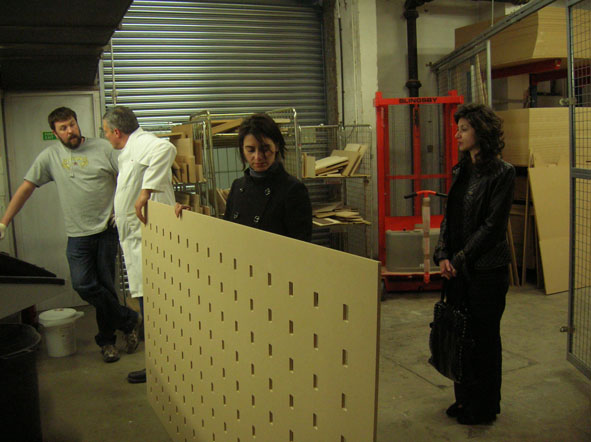
I am referring to Silvia's work title, which is the product of how the piece was born and why. I am not going to tell you all about it at once, though...better coming to the show to appreciate it in full! Today, we experienced the actual making of and saw it unfold and live before our eyes, at least in pieces. A big THANK YOU to the technicians at London Met wood workshop, Stuart and Jennyve in particular, for all their help today: we couldn't have made it without you guys and your patience. If you remember this post, you'll know now that we found a way to have this incredible piece on show.


When I left Silvia dealing with saws and messy measurements and entered our office, I was delighted to find Nathalie's work delivered: two collages, a big and a small one, very different from each other and therefore absolutely interesting. One in fact looks like a proper environment, almost another space with round elements floating in it regardless of perspective or gravity rules. The first word that came to my mind was: pop. And then, equilibrium. Peace.


Francesca is working on the screen for the projection of Guszstav and Katja's video. Today the built frame was delivered and we also have the black out material. The idea is, for the screen, to be perpendicular to the wall, like a floating canvas and work like a door, with hinges on the wall that allow it to be open or close, according to necessities.
We mustn't forget that Unit 2 will host also the talk and performances by, respectively, Cesare and Sophie, therefore we will need space. Literally. There's always a negotiation with the space.

We sorted out who's delivering what work and when for this and next week, and learned that Dylan is going neon. At the beginning I misunderstood and imagined a structure made of light, whereas what Habs was talking about is the colour of the structure. This activated Silvia and an interaction between artists begun: which colours shall she paint her switches in order not to clash with neon orange?
We'll know the answer to this question quite soon-ish.

Saturday, 20 March 2010

First Meeting: where we stand


I know, it is a bit too late for this since we had our first meeting...hum...two weeks ago now! But, as you might have perceived by now, I do like blogging and would like this experience to remain somewhere, even lost in the internet's mesh.

It was the 10th March, a grey afternoon, when this show finally took on some kind of definitive form, which now needs to be adjusted, polished or even reviewed. We went to The Big Chill Bar on Brick Lane, perfect if you are on a tight budget but nonetheless need something to eat to get the brain spinning. Maybe we had no idea that we were to spend all the afternoon there. The first point of the meeting was: which artists do we want and why? And there, our coherence of selection finally showed: five different heads came up with eight/nine very different artists who, thought, share similar concerns about the identity of the space we are trying so hard to nail down.

We started considering Unit 2's space in particular as active/inactive: show/no show; like a brain in a body and its various connections, a mental space. This clicked with Sophie Vent's practice of mapping: a map is a type of space, a way of setting boundaries and crossing them. She will identify a map of the endorphin when it's released in the body and then translate it to a dance with the collaboration of a choreograph. Will thinks her idea to have the choreography danced by children and filmed on video is great. Going on on Unit 2, we already said that the access is restricted: the gates will be opened during the opening, but then only people with budget will be admitted in. So one question might be: who is actually going to see the show? That's when Russel Chater steps in: he is "seeking to explore spaces and states that are in between or beyond". He will cover the window with a white element used to cover derelict spaces, blocking the view from outside. During the opening, people will be invited to draw or write on it, leaving a trace on this temporary space and, most important, allowing people from the street to peek into the gaps and take a glimpse of the space. Habda also proposed other two artists, Charlotte Bracegirdle (whose practice is already explained here) and Nathalie Guinamard: with her, we enter the realm of displacement; she works with collage, selecting unaltered sections of interiors and exteriors and seeing how they work in juxtaposition: spaces in between become even more important than the visible space itself; perhaps she will work on what she'll see in-between Unit 2, and we'll hopefully discover new connotations.

Although her work will certainly be the most complicated to install, Silvia Iorio is still up with her switches installation, described here. The lamp bulbs will be all outside Unit 2 and, apart from some that we'll try to keep visible, when someone presses the button imagination will take the lead to identify where a lamp bulb is actually going on and off. Light will cross the space's boundaries, showing it for what actually is: infinite. The space as interface, meaning point of interaction, is represented by the video artists Katja Pratschke and Guszstav Hamos, whom Francesca met at the Tate. It may seem that the body and its connections are the protagonists again, but in this case it is the space of the video as a medium that is questioned through the display of still and moving images. Last but not least, Martina Geccelli, sniffed out by Clementina. A German artist with an Italian name, Martina works with photography in connection with architectural and sculptural conditions. She shoots everyday, banal objects like books or cardboard boxes to show their often hidden relationship. We all liked very much the picture of two cardboard boxes arranged upside-down, holding up in a precarious balance enhanced by their almost touching flaps. Another kind of space, defined by its limitations, the physical outlines and that in between.

Wow. A lot of concepts have been dished out here, but personally I see no discrepancy between our artists. I see something that has just started to build up. Now we would need someone authoritative, a dead or alive critic, with a strong "space" concept to place at the beginning of the critical text, in order to convince us all that this is the right track.
Isn't it?

Saturday, 13 March 2010

A bit of info


Here's a quote, which summises a little of what I feel about exploring the notion of Unit 2 being an exhibition space:

"......that space becomes a question, ceases to be self evident, ceases to be incorporated, ceases to be appropriated. Space is a doubt: I have to constantly mark it, to designate it. Its never mine, never given to me, i have to conquer it"

"spaces melt like running through your fingers. Times bears it away and leaves only shapeless shreds"

Georges Perec, Species of Spaces and other Pieces, p.91 c

About an artist:
Charlotte Bracegirdle (fabulous name!)
She interupts the scene of famous pre-modernist paintings e.g Courbet's The Artist's Studio, see above. Original can be viewed here.

She uses prints which she then paints in the detail, so she is adding to subtract. Charlotte makes her alterations honest and visible from the disturbed surface of the print and the slight reflection from the paint that she uses. In other words she doesn't choose to hide her hand and thus adds to the discourse of the original piece.
I like the way in which she plays with the notion of a space within the painted image, however not sure if the aesthetic of the piece suits our show - it could be a good point of difference??


Posted by Habda


Tuesday, 9 March 2010

Suz has gone into a lot of depth about the idea of space - nice and juicy stuff. Cheers for that, love. I'm still not really sure what I make of unit2, I really don't like its name and the other day coming out of Whitechapel across the road the vile purple sign above looks more like a shit Birmingham night club than a gallery.


Sophie Vent, a recent graduate from Goldsmith, has agreed in principle to be in the show which is more than exciting. She works in a really interesting way which I wont try to explain but instead push you towards this link where you can see some of her lovely work.

I'm not sure that we are at a position to go into details of the work that she will be producing for us. But she will be making new work, its performance based. And may involve live children.

I think that we are getting to the point where we will be outlining more of a concrete idea of the exhibition, with artists and perhaps some nice talks or events. Maybe even a catalogue if you're lucky.

Getting back to the issue of space as I feel I possibly should George Perec is always a nice one to read, Species of Spaces, a particularly good choice. I'm not really sure how relevant it is to this show but I'm sure it probably will influence my input as these texts always seem to. He rambles in a nice gentle tone, picking up objects and parts of our surroundings that seems droll to most of us and pulls some little gem from his lovely little head.

bye now.

Posted by Will

Again about the concept of the Space

I am just browsing Foucault's "Of Other Spaces".
At the very beginning of this show's planning, Habda mentioned the concept of Heterotopia. If you don't understand philosophy, like myself, it can drive you mad. But the minute you understand it, a whole new world unfolds right before your eyes, and you start to wonder how is it that you have wasted so much time without even trying to approach such books, too scared to feel like an idiot in front of the vastness of such concept. Just the first two or three lines of that small essay were illuminating.

We decided to write a short paragraph each about our conception of the Space, so I'll try not to cheat, reprising the philosopher's words, and go for what I feel, and know, about it.
For me, the space in relation to an exhibition is like an interface between it and the showed works that is undoubtedly necessary but could, in a way, be defied. Of course, an artwork needs to be in relation to the space in order for it to properly communicate with the viewer, but sometimes the view of the space seems to take over and influence the work's display too much. There is only one example, in the case of the "space taking over", that comes to my mind: Kiesler's space for Peggy Guggenheim's gallery, The Art of This Century (1942).

Unit 2 is a space with a strong identity, meaning that it isn't an actual commercial gallery, or a museum's section, which may both be considered as mere containers where just artworks do the talking. It is in response to this identity that, in my opinion, we are choosing certain artworks and artists to create the show. So far, the proposed works all require the public to interact and create different means of communication beyond the space's physical boundaries. This should activate a different perception of the space: not just a mere container, but an active entity that works with the artworks without overwhelming them, and creates an experience for the public at the same time. As an active entity, the space can be considered organic, and consequently become active or inactive, opened or closed, intersected or left to be, expanded or contained. All this sounds very elusive, but I am sure I can define it better by the end of the month. At least, it's a beginning.

Two words about the picture I have put there: it is by Luisa Lambri and represents Oscar Niemeyer's Casa Das Canoas in Rio De Janeiro. Try to take a step back, just before I revealed what it is: does that space look like anything recognizable in that picture? Lambri's practice, extended from spaces to places, is about a personal interpretation (not documentation) of the space, which leaves the viewer with no reference but, in turn, a different personal perception of it.

Friday, 5 March 2010

Black and White Berlin

Last week we went to Berlin with our tutor for a four days full immersion in the art scene.
It was really great. Berlin, which not all of us visited before, looked like a black and white photograph: the sky was grey and the streets covered in snow, salt, ice and dog's dung.
The presence of the war strikes you there like nowhere else: missing houses, bullet holes, silence and cranes everywhere. I had the sensation that Berlin never fully recovered from that, including the heavy heritage the war brought along.

But the art scene is something different: it is like East London in its golden days. Not spoiled yet, vibrant, affordable and with a definitely different attitude. We met curators and artists, and all were keen to talk to us open hearted about their different experiences, even if this required a good deal of chance and improvisation. In plain words, less academism and more generosity. A big, international artist community is operative in Berlin; I would have never imagined to catch up with some of my peers, totally by chance.

Of course, this brought new lymph to the show: we met Italian artists Silvia Iorio and Cesare Pietroiusti. Me, Clem and Fra went to Cesare's talk at the NGBK and found his dissertation about how he conceives the space truly inspiring. I will just quote one single sentence from that night, which in my opinion says it all:

"When I was eight, my family and my grandparents used to live next door to each other. Every night, I would go to bed at the same time and my Grandmother would knock from the other side of the wall, just to wish me goodnight. I then started to think about how I could reach the other side to go and see her whenever I wanted, and the most obvious way was to dig a hole in the wall. I would hide under my bed and work on it with an accomplice friend of mine. When my mother discovered it, she wasn't very happy. I have quoted this episode because I think that my whole artist career is an attempt to get to the other side of that wall, but I am still stuck in the middle."

Silvia is an old friend of mine, even from high school. Our paths always crossed since then, and always by chance. It was a pleasure to find her in Berlin. We shared a table at the traditional German restaurant Max & Moritz and got totally taken away by the description of her work. Science and art, in a charming mix. She told us about how she, herself, tried to defy space's boundaries by using light as a mean of communication. She created a work with colored switches connected to lamp bulbs which can be dislocated beyond the gallery space - in a building nearby, in another room, even in another area - and can be turn on or off, perhaps used to send a message. Space. On. Off. Something clicked here.


Friday, 19 February 2010

The issue of the space

Hum.
I have been surfing the net for an image of Unit 2 Gallery, the place where we are going to install the show in a few months' time. This is all I have found, which gives absolutely no idea of the space we have to confront with. We popped in the other day to see the present show (which isn't on the website by the way: no updates since April 2009) and found ourselves walking into a narrow and long room, with a glass window and door at the bottom.

The only access is a door behind the University's gates, which are accessible only if you are a student and possess a card. Should you forget your card home more than three times, access will then be denied to you. Habda asked if the front door on the street could be opened, to facilitate people's access, and the answers were: "Yes of course" and "Absolutely no". We still have to find out which is the correct one.

The relationship with the space is quite an interesting point each curator has to consider sooner or later. The artworks can just be traditionally exhibited on the walls, or put in a tight dialogue with the space itself, which can be altered, changed, according to the nature of the show. There seem to be no written rules of display, and I personally do think that sometimes a good setting just comes from a right sensation "in your guts", like some dealers like to say.

Some of us are very interested in the space, especially with the concept of active and inactive. Unit 2 is an exhibition space inside a public building, like a brain in a head, and this already puts it in a peculiar position. Artists who work on the space, investigating it, modifying its perception, have been proposed by Habda. She sent a link today to a very interesting artist, Russel Chater. He works with displays holding nothing, playing with the notion of the Arcade and realizing objects between minimalist, formalist and kitsch aesthetic.

Clementina is really interested in the concept of the maze, and would like to use it as a display device, whereas Francesca took some examples of Theo Vandoesburg 's paintings and showed them to us like they were a map of a space seen from above.

I won't give away what Will is working at, instead, because he may blog it himself. Come on, mate!
As for me...well, I have a very complicated relationship with the space, it's still kind of tough to me and it shouldn't interfere with the artworks too much. Therefore, I am still working on it.