Showing posts with label Considerations. Show all posts

Friday, 28 January 2011

Yesterday


There are some days when everything goes wrong.

It starts with one event, and then the chain of bad luck follows, like it was called by some sort of jinx sorority. But, there also are days when exactly the opposite happens.

First, it started with a dear friend of mine giving me a great news: he has a girlfriend. Actually, he did pronounce the word "engaged", but didn't exactly tie the knot since they've been going out for just a couple of weeks...and been knowing each other since childhood. I was so happy for him. After five or so years of being single, spent trying to forget the only girl who broke his heart, who's now happily married and with child, he merrily tells me that he has fallen in love again. 
I kept on telling him, it will eventually come to you one day if you only stopped searching...love is always unexpected.

Secondly, in the afternoon I had one of those experiences that throw you back in...well...sixteen years' time in the space of a second. A famous pop star popped in my workplace.
One of those people you worshipped when you were sixteen and, despite this made you the joke of your male friends and the desperation of your parents, you still remember the times spent singing the songs over and over and hopelessly waiting outside an hotel with your mates as really good fun. 
Not "the best times of your life", no...those would have come later.
I remember the frustration, though. That of spending so much time trying to see a person in a context that wasn't a gig without actually succeeding. You know, closer look, not just the miniature, big screen or TV version. Well, yesterday, without any advance notice, he was right in front of me.

At the beginning I thought OK, I can handle this (after having pinched hard my poor colleague's leg as soon as he stepped in). Couldn't really control heartbeats, sweating hands and - hopefully unnoticed - rash reactions, though. Damn, I thought I was a mature grown-up woman, but at that very moment I was back a teenager every inch.

"I am just having a look around." He said. 
And I replied with something very intelligent like: "Er...sure."
AskhimifheneedsanyhelpatallforGodssake! 

The result: my colleague maintains that I scared him off and he is never coming back. Just because I collapsed on the floor behind the counter when he left (pathetic, I know) and she claims that he saw me (no, he didn't). Despite losing the dignity, this banal event put a smile on my face: eventually, things come to those who can wait.

Precisely, there it arrived an email at the end of the day:
"Your exhibition proposal has been accepted." 

A curator friend of mine once quoted a passage from "By Nightfall", a novel by Michael Cunningham. 
It was a conversation between someone who wanted to become a curator and someone else, who compared the choice to that of wanting to become a movie star: obviously very few succeed.
True, but some do succeed the first character replied.
Well, that "yes" was coming from a Museum I worship and, if I have to draw parallelisms between curatorial and cinematographic careers, this would definitely be compared to being the leading actress in a Fellini movie.


Wednesday, 19 January 2011

The Eighth Labours of Hercules

Imagine you are writing a text for a catalogue, something of academic nature, developing one aspect of a potential show.

Imagine the selection of the books to prepare your dissertation, starting with database research and meticulous investigation of the footnotes, to find further references.

Imagine a thorough reading of all the sources, including books you never dreamed of approaching like Hal Foster, The Return of the Real. Fabulous, but your brain asked for mercy and your neurones went to the gym to potentiate their evidently weak connections. You still are not sure about what you've actually read.

Imagine to sit in front of the computer, staring at the screen, because the paragraphs you took two days to organise don't really make any sense and you know that.

Imagine to continue reading the books over and over again, desperately trying to find the connections you are seeking.

Imagine to finish writing at 10 pm of the night before Consignment Day: your eyes are as big as a satellite dish and the curve of your back has increased of at least another couple of inches.

Now, imagine to do all of this in another language.


> Washing the Christmas tablecloth at the end of January? Curator's Stuff

Sunday, 19 September 2010

Designers, Artists and a touch of Red Sea

London's Design Festival 2010 is upon us. This sounds like a daunting sentence, but in fact it's just that there will be so many events scattered around town that you won't even know where to turn. Yesterday I gave it a start by going to an exhibition mixing together artists and designers in a former factory listed for demolition. In this difficult economic climate, pop-up shows in abandoned or empty spaces are thriving, giving creativity the chance to fill in the void and reinvigorating the old concept of philantrophy. I must confess that I am very fond of such spaces: their roughness, the mouldy walls, uneven floors and gigantic windows give a different flavor to exhibitions, dragging them closer to the viewer, lowering down the "sacrality" of the space to a much more relaxed experience. Of course the artworks are still for sale, but it won't be only about that.

Sure enough, when I popped into the huge room all I find is groups of friends, beer in hand, chatting among each other. The works occupied the space evenly, from objects like customizable squared ceramic vases or an interesting table lamp that is actually a lamp-table to a large size picture on the wall and a sculpture made of wood bark appearing behind a mirror. The boundary between design and art object in this show is indiscernible, because none of the design objects seem to aim at being functional. I guess the only difference is the interaction: you normally can't touch an artwork, whereas you'll definitely want to touch, for example, Alison Dunlop's corner mirror made of many leather gusset that you can open or close as you please, creating different patterns on the interactive surface.


I. Loved. It. Why? Because it becomes your playground, and your mark will be upon it until the next person decides to change it. It's democratic, ever-changing and not functional, as the reflecting surface doesn't really do the job. It's an artwork that you can touch and change.


Next door to all of this glittering and clattering, another show was there to be discovered, announced just by a timid red candle.
Inside: myself, two artists, and another guy. In terms of affluence, it reminded me of my openings. Maybe attracted by the empathy, one of the artist immediately approached me. She was elegantly wrapped in a white cloth which had the same consistency of sails and wears dizzy high black heels, her hair tied up and hanging down scruffily, making her look like an underwater mangrove:

"How did you hear about this show?"
"Er...I am coming from the opening next door..." No offence, we both are foreigners who go straight to the point. The Importance of Not Being Earnest rule doesn't apply here.

She handed over some literature with scatter sentences about the need to "invest physically" and "relating clothing to circumstances / creating history / sharing its process". I learned that the artist Arunas Survila "has gotten involved", but the girl's name was nowhere to be seen and I soon forget it.

She informed me that there will be a performance, later, and showed me some clothes, hanging from ropes, that were left soaking in the Red Sea. The process was filmed and the fabric felt heavy and rough under my fingertips.
That had the power of a Proustian madeleine: suddenly, the long gone days at sea in a summer that unfairly lasted too short came back to me, the salt flavour in my mouth, the thickness of the sea water permeating and beating my days.

Some other clothes had a less nice fate: they were filled in with raw meat and left to be tore by stray dogs: "There are a lot of stray dogs in Russia, you see?" she told me. Well, I think, I guess they had the time of their lives thanks to her. So why she did that? "To create patterns on the clothes", is the answer. Also, she wasn't very happy about the result because the holes are in far too precise points, they seem almost industrial. She described the whole process as "very hard and disgusting', then gave a good sniff right on the dried blood: "You can still feel it."

But I still don't get it.
Don't get me wrong, Mangrove, I did like your installations and think they had some potential. Some thoughts and sensations are still stirring if I think about it. But honestly, next time, just find yourself a curator. As I should find myself a PR.


Saturday, 4 September 2010

Message in a bottle

"Walked out this morning, don't believe what I saw / Hundred billion bottles washed up on the shore / Seems I'm not alone in being alone / 
Hundred billion castaways, looking for a home." 


Trafalgar Square on a cloudy Sunday afternoon is a place bursting with people: Londoners, tourist competing to have a picture on the lions at the base of Nelson's column, families with children running around freely, skating teens. I have a very nice memory of an hot afternoon back in 1993 when I had my first school trip to London to learn English: people were bathing in the two fountains, with children even wearing bath suits. Of course, although I was fully dressed, I joined them. Not even in your most forbidden dreams would you do it in Bernini's fountain in Piazza Navona, Rome: you'll get arrested on the spot, no questions asked.


At that time, I didn't noticed the empty plinth. 
It sparked my interest when I learned, several years later, that it was being used to commission temporary site specific artworks: from Rachel Whiteread to Marc Quinn, the plinth joined his equals to host contemporary art which exquisitely mixed up with the eldest in the monumental square.

Now, under the corner stare of neighbor George IV, the Fourth Plinth hosts Yinka Shonibare's Nelson's Ship in a Bottle. You would say it is overshadowing from the pictures and the various reportage on TV; instead, at that height the bottle seems contained, almost disappearing compared to the imposing plinth. A little monument for a big square, directly linked to the historical victory of Nelson at the battle of Trafalgar at the beginning of 1800, which freed the seas allowing England to get in touch with different cultures, and to become the cosmopolitan country we live in today. The colored patterned sails, made out of Shonibare's trademark African textiles, refer exactly to this: the British colonialism legacy.


The so skilfully realised ship, rich in details, is enclosed in a giant bottle, like the tiny traditional handicraft work; this seems to make the concept behind its creation small and contained, almost silenced. Shonibare is not an artist who leaves anything to chance, therefore even the fact that you can’t really make out the ship’s details nor the sails patterns by looking at it from the bottom of the tall plinth means something.


It’s the first time that the empty plinth hosts a work so directly linked not only to the history of the square, but also to the city of London in particular. The multiculturalism and immigration Shonibare is talking about is all there, making London the seaport she wanted to be: people arrive and leave all the time. Maybe they'll leave traces of their passage, maybe they won't. Strangers are so many in this city you can hardly make out the features. Multiplicity often leads to confusion, and then tolerance steps in: polite smiles, shifts to one side to make some more room, just a tiny bit. London’s social and cultural structure is indeed a very colorful and patterned fabric like the one in Shonibare’s ship, but every community is an island, trying to look at one another from too much a distance to figure out the details.


An updated version of this post is going to be published as an article on the magazine Arte e Critica n.64

Thursday, 12 August 2010

There must be a reason

With every preparation of a show, here comes the moment every young curator dreads the most: sending the Press Release.

If you don't have the luck (or funds) of having a proper Press Office doing it for you, then be prepared for a good deal of stress which will probably end up in calling the computer every name under the sun or, more politely, putting your hands in your hair not exactly to pull them out, but to prevent them from falling off.

Too melodramatic? In the end it's not a big deal, is it? It's just about sending some emails... well, there must be a reason why people study hard to become Press Officers.

First of all, dealing with the press means tight deadlines, well in advance of the event, which can't be ignored; therefore you need to squeeze your brain out and get the press release done before that date. If you have the writer's block or suffer from chronic perfectionism, you're screwed.

Once everything is nicely ready, the image is in place in the email's body, the writings make sense - not too boring, not too long - and the timing is right, you suddenly realise that you can't send it at once to all your contacts. Most of the on-line email servers now have anti-spam filters activating themselves as soon as you try to go over, say, two-hundred emails per day - Two Hundred! Wow, you have a hell of a mailing list! - OK, people don't like spam and that's a fact, but there is a difference between selling Viagra and informing about an upcoming show... I am sure these spam filters, which must have been devised from the CIA's greatest geeks, are aware of the email's content.

How do you solve this? By splitting your contacts in not too large groups. Ype, but this takes half of your day. Moreover, you can be the most organised and precise person in the world... there will always be a skipped, forgotten or even added twice contact ending up in the wrong group. Like That Gallery Director getting, together with the show invitation, a personal message saying: "Hello dude! Hope to see ya there!" Face it: you're not Superman.

After having tried to pull your eyes, that have started twitching, together, you are ready to press the 'Send' button. Read it again.
Adjust that double space.
Add something.
Delete something.
Wait! Don't forget to add the Bcc otherwise every contact will see everyone else's email and they are going to hate you.
Ah! Add the disclaimer, too. Explain to people why they are getting this email, that you are blah blah, rules about privacy, blah blah blah and that, if they don't want to receive such information anymore, they can unsubscribe.
Put your email in the "To" field, so you can monitor everything.
Done. Take a breath... Send.

Aaaaah, first batch gone, you start to relax and even to feel smug. Piece of cake! You receive the email that you have just sent to yourself and...instead of the image, there is a nice blue square with a question mark in it. What the hell? Simple: the image has jumped. That's when you start to loose it because you just have informed a group of people of a show about a work that they can't see. And it's not just any group, like "Friends" who will definitely understand: it's "Press". This doesn't really help.

To avoid repeating the embarrassing mistake, you start all over again, create a new fresh email, re-add the image, and avoid the "Forward" button like the plague. This, for five or six times minimum, depending on how many "Groups" you have. In the mean time, is 1.59 am and you have been at it all day. Well, at least it's done. Life is beautiful!

The day after, you open your email account to finish sending the invite to the rest of your contacts - you were clever enough to keep the ones not subject to deadlines for the day after because the spam filters have indeed blocked you. - Among the many "Out of Office" auto-reply and failure notices because you typed 'hitmail' instead of 'hotmail', what do you find?
A couple of "Unsubscribe". Like this. No reason given.

Well now, after all you have been through!

Tuesday, 3 August 2010

Behind the scenes

It is a customary complaint nowadays to say that we are continuously bombarded by images. 

This can be a valid example...


...watching TV with The Bay Window on can become quite interesting.

Saturday, 31 July 2010

Wicked. A nostalgic bohemian feeling

Yesterday, Hackney Wick opened its doors, and artist's studios doors, to the other side of the world for a three-days art festival. 

For a non-English mother-tongue obsessed with grasping every nuance of words' meaning, the name of the festival is a delightful and clever language game, swinging between "cool" and "bad": wicked. Very appropriate, if you consider that, as soon as you get off the overground, in normal days you would find yourself in the middle of nothing. Instead, the industrial and unattractive buildings (which, in fact, I find fab) are studios and homes for a large community of artists.

It feels like landing in another world, which you have to explore just with the aid of the - few - tools in your possession (a map of the area highlighting the main events' location) and a good dose of interpersonal skills, especially in  matter of orientation. The territory is not hostile of course, but you do feel like an outsider and start following the other +people, who know exactly where to go, like a stalker.

The many events were just unfolding around us, we could hear some music and percussion coming from the train station exit, and we had just missed our place at the dinner/performance organised by the curatorial collective Cosmicmegabrain. I just had the time to see one of the curators rushing to the terrace in Oslo House, wearing a shiny yellow foil hat with some flowers and cherries sprouting out of it. This is what I call landing on the job. After having bumped with pleasure in the only artist I know in the area (Martin Weswood, ndr), Habda and I ventured to see the studios and some art in the making. That was when I had the bohemian attack.


Known also as the Late Bohemian Sindrome, this rare and unlikely illness strikes subjects who are particularly sensitive to large, loft-like spaces, possibly with mezzanines, where art, great second-hand furnishings and private life are equally mixed. The first symptom is that the mind starts to wonder, imagining night parties like sin and a continuous, often stimulating confront with your neighboring peers. The attack carries on with drooling, a good dose of envy, loads of mental notes like the-day-I-will-have-my-own-house-I-must-remember-this-arrangement and, finally, it quickly fades away with the very down-to-earth thought: "But there is a common loo. No shower." The bohemian feeling lingers, though. The idea of something going on which maybe won't lead to the next generation of star artists to be born, but it will certainly be a tale to remember and tell: When I was twenty, I had a studio in Hackney Wick which I transformed into a living unit. I was painting everyday and partying every night - or the other way round -, we would talk a lot about art with the others and sometimes young critics and curators would join us. We organised shows and events, made things happen and... All right, I'll come off it.  It just made me think that all the famous artists and curators we know must have started like this: with a beer, a romantic kennel and a good chat. That's what they must still be doing, actually.

Moving on, we managed not to miss Roberto Ekholm's performance The Magnetic Man inside the show La Perruque: inspired by Michel De Certeau's writings around cultural practices and relationships, the show tries to manipulate commonplaces and make them habitable, which is to say, to use your own creativity space into the rigid and framed working society.

The evening was concluded with a quick - rainy - shower and my venturing up an emergency iron ladder to go to one of the building's roof and have a glance at the city landscape. On the other side of the river, the Olympic Village is taking shape and I couldn't help but wonder what will it be of these guys once this is turned into a fashionable residential area. Below, lights were glowing from the opened spaces, with people milling around, commenting the latest works. Looking down, De Certeau sprung to mind again for his most famous writing about the practice of everyday life (1984): the city seen from above is the result of the institutionalised bodies, who organise it in a grid and try to direct the experience and gaze of the person traveling in it. Below, people continued to get lost or get rid of the map, following their instinct instead, enjoying the dรฉrive.


Tuesday, 11 May 2010

It's Wednesday already and I am not.

If you're thinking that this title sentence doesn't make any sense, you're probably right.
It is inspired to the title of a book by Italian writer Alessandro Bergonzoni, who just wanted to say, in a very philosophical way, that he wasn't ready for something. His whole being wasn't ready.

Tomorrow's the big day.
We have worked hard, the artists have worked hard, nonetheless some big issues still need to be sorted out; I know is normal when you deal with organising a big event as such with, literally, your bare hands and your personal - limited - knowledge of practical stuff.

The curator, this essential and yet undefined figure, is here divided in two parts: from one side, the intellectual one, the one who devises the show and all its cultural implications, who makes the connections between the works and makes people see the message. 
From the other, the practical one. Someone who can build a frame, screw nails without screwing up things, hang stuff from the ceiling if needed and has a very, very deep knowledge of any material, from the reactions of paint to fingers touch to how to bend metal and make a projector cage out of it.
As for our little team, I can proudly say that we include both curators type. Half and half, evenly split.
Anyway, like it happens when you play Monopoly, unforeseen events happen.

Tomorrow we open at 6 pm.
I promise to put a post up as soon as the setting up is finished, just to be able to look at it in a while, maybe a week later, and see what the time was, when it was posted.

Wednesday, 5 May 2010

The Odyssey and other journeys

We are a week away from the opening.

When I think about how quick all that time passed, I can go nuts. From now on, I will commit myself and put one post per day, just to keep everyone up to date. Thank you for following us so far.

Now, just before collapsing on the bed, let's talk about the Odyssey. 
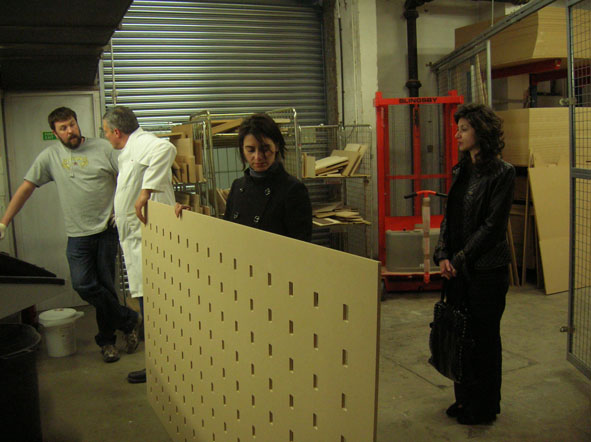
I am referring to Silvia's work title, which is the product of how the piece was born and why. I am not going to tell you all about it at once, though...better coming to the show to appreciate it in full! Today, we experienced the actual making of and saw it unfold and live before our eyes, at least in pieces. A big THANK YOU to the technicians at London Met wood workshop, Stuart and Jennyve in particular, for all their help today: we couldn't have made it without you guys and your patience. If you remember this post, you'll know now that we found a way to have this incredible piece on show.


When I left Silvia dealing with saws and messy measurements and entered our office, I was delighted to find Nathalie's work delivered: two collages, a big and a small one, very different from each other and therefore absolutely interesting. One in fact looks like a proper environment, almost another space with round elements floating in it regardless of perspective or gravity rules. The first word that came to my mind was: pop. And then, equilibrium. Peace.


Francesca is working on the screen for the projection of Guszstav and Katja's video. Today the built frame was delivered and we also have the black out material. The idea is, for the screen, to be perpendicular to the wall, like a floating canvas and work like a door, with hinges on the wall that allow it to be open or close, according to necessities.
We mustn't forget that Unit 2 will host also the talk and performances by, respectively, Cesare and Sophie, therefore we will need space. Literally. There's always a negotiation with the space.

We sorted out who's delivering what work and when for this and next week, and learned that Dylan is going neon. At the beginning I misunderstood and imagined a structure made of light, whereas what Habs was talking about is the colour of the structure. This activated Silvia and an interaction between artists begun: which colours shall she paint her switches in order not to clash with neon orange?
We'll know the answer to this question quite soon-ish.

Saturday, 13 March 2010

The Kite Flyer


Sometimes thoughts just strike at 8:30 in the morning.
I was thinking over the relationship between curator and artist just in front of the bathroom mirror and came up with this conclusion: a curator is like a kite flyer.

I like the idea of the artist as a kite: they like to fly free, beyond imagination, and sometimes above reality. If there wasn't that tiny string linking them to a flyer, they will get lost. Or crash on a tree. Or smash to the ground when the wind stops blowing. On the other side, the curator leads the kite, guides it, but cannot totally control it. Even pulling the string doesn't guarantee the kite to follow the instructions; it may start turning, twisting and flipping, because the wind is too strong. And paying it out too much string may bring the kite to fly too far away, and eventually fall. Sometimes, kite and kite flyer found themselves stuck: when there is no wind, no matter how hard they try. When the kite gets stuck to a tree, and the kite flyer somehow has to rescue it, trying to minimize damages. Sometimes, the kite would surprise the kite flyer by doing unexpected acrobatics, things that happen by chance and can only be repeated through experience, time, trial and error.

That's a very special, complicated relationship, based on a delicate equilibrium. The string that unites them doesn't mean subordination, for any of the two. It's about working together and be able to fly high without falling. Kites and artists are very fragile, and sometimes curators and kite flyers are inexperienced. But all can be fixed, including flying skills and torn paper, if they learn to trust and support each other.