Showing posts with label Curating. Show all posts

Monday, 17 October 2011

A Two-Times Exhibition: Silvia Iorio's Odyssey 2010 | Odisseia 2011

Perhaps some of you remember this post.
It doesn't say much, it is just the Press Release of the first show my colleagues and I curated as part of our  MA in Curating the Contemporary at the London Metropolitan University, which we successfully completed this year. Instead, that simple post - and show, is the start of something unique.
Something that needs to be read through the lines to be caught and understood.


But let's proceed in an orderly fashion.
When we involved artist Silvia Iorio in this show, she conceived an artwork, Odyssey, which was to be further developed in the upcoming year. The challenge presented to her to go beyond a clearly defined site, and pierce the walls of a space, was met with the idea of creating a two-times exhibition.
Odyssey is a panel with 160 coloured switches "that people were invited to activate during the opening night, on the12th of May. No light would go off at the same time, though: the artist decided to stretch this event in Time – and Space – by having the Light travelling through the Universe for One Light Year. An unconceivable distance for a human being, as it is the speed at which the Light travels (...)
Through Silvia Iorio's eyes, the journey of Odyssey’s Light reached even the most remote and unknown points of the Universe. The various stages of the journey would have been impossible to document had it not been for the experiences of the people attached to them. As part of the project, the artist created the conditions for those who participated to Odyssey to re-interact with the artwork: every 12th of the month, for 12 months, they received an email with questions about what they were doing at a precise time, what they were thinking, and if their mind and body were “connected”. How many times are we caught in the middle of doing something, but our mind is elsewhere? Yet, mind and body are closely interconnected, like the switch and the light. Through the answers she received and collected, Silvia Iorio was expanding the concept of dislocation and taking it onto new levels."*


Silvia Iorio, Odyssey, 2010, One hundred and sixty switches, MDF, enamel, aluminium and wood, 224 x 118 cm


Now, what happened after a year, namely this year 2011?
The first thing to say would be that artist and curator, too, were dislocated. The artist was in Berlin, the curator in London. The two of them were disjointed, their dialogue possible only through modern technology. As the dialogue between Odyssey and its twin work Odisseia, everything seemed hard and impossible: how can it be that two different events, happening at a different time and place, are brought together and re-connected in a solo show? Initial ideas were discarded and a more complex outcome took form, the barriers of space and time acting as incentives. It couldn't have been just the same panel, with 160 lamp bulbs bearing the same colour as the switches, and lighting up in the same sequence they were activated one year before. Very predictable.
But Silvia Iorio is an artist of many resources, and surprises, as sometimes Science is. 
Therefore, the Light manifested itself through imaginary Celestial Maps, from where unknown stars, which are lost in the vastness of Universe, shine for real for the eyes of those who can see them. 
They shine for the eyes of those who see the created connections. Light came back to Earth, and earth made its appearance in the gallery space. 21 people among many who activated the switches, one year before, were the most regular contributors in answering Silvia's question about their whereabouts. 
Their coloured experiences materialised in the form of 21 light terminals, and here the circle clicks, and closes.


And to think that everything happened by simply turning on a switch!
On September 22, 2011, the exhibition Silvia Iorio Odyssey 2010 | Odisseia 2011, was successfully concluded.


Silvia Iorio - Odisseia 2011, Installation view


Odisseia 2011 - Celestial Map, detail, dimensions variable 


As I told Silvia, I find her watercolours nearly moving.
To imagine corners of Universe no one will probably ever see, but that she was able to evoke thanks to the inspiration of Light travel and people's experience, is a gift. 
The experience of the casual viewer included, of course, the fact that seeing is believing.


P.S.: I am happy to mention another show that successfully featured the Celestial Maps, which are having a great and well deserved success: Silvia Iorio, Age of Time. Edge of Space, part of the ongoing show series Rendez Vouz Mit Kunst at the Restaurant Diekmann in Berlin. The show, curated by Isabelle Meiffert, was on until the 8th of September. An installation view is below and more pictures can be found here.


_________________
(*) Extract from the catalogue's text. You can read the full version on the Galerie Mario Iannelli's website.

Saturday, 17 September 2011

24 June 2011: She Devil 5, Rome > Kate Street

In a young Curator's career (or "career"), there are certain occasions for celebrations. You know, little small satisfactions, like when you select a talented video artist whose work is then included in a group show, and the screening happens to happen - hear ye! - in your hometown's Public Museum: the MACRO - Museum of Contemporary Art Rome.
Your name, together with those of other 12 remarkable colleagues, shines in small white letters on a black panel, and your little critical text is printed on paper handouts, and passed from hands to bags.

I saw Kate Street's work for the first time at Nettie Horn and always wanted to realise a project with her. Some fortunate circumstances made this possible in grand style, and for it I am grateful to the artist and to Italian gallerist Stefania Miscetti. But let's skip the chatting and go straight to the copy-and-paste of what the event was all about, plus some pics of the evening.

This is the Press Release:

SHE DEVIL was devised in 2006 by Stefania Miscetti for Italian and international female artists and curators, from the youngest to the most successful. Different works and critical perspectives coexist in a multivocal discourse which reveals the many facets of the female world and vision. This broad spectrum of activities and aims can be seen in the exhibitions that have been organised over the past years, which have included 40 video works and involved 24 curators, as well as a special international edition held in Bucharest in 2009.
As part of its summer 2011 exhibition cycle, MACRO is hosting a new edition of the project, now in its fifth year, an event that is perfectly in line with the galaxy of cultural and artistic proposals that have defined the identity of the Museum over the past few years. On the opening night the videos in this new edition will be presented in the conference room of the Museum's new wing, the nerve centre of the New MACRO exhibition area. The wing, too, was designed by a woman, the architect Odile Decq, thus it is the perfect setting for the presentation of the video works.

The Fifth Edition is curated by: Antonia Alampi, sybin - susanna bianchini, Benedetta Carpi de Resmini, Dobrila Denegri, Maria Garzia, Laura Giorgini, Maria Cristina Giusti, Caterina Iaquinta, Manuela Pacella, Cristiana Perrella, Lydia Pribisova, Elena Giulia Rossi, Chiara Vigliotti.


Thirteen videos by International female artists were presented, among which Kate Street's Flowering, 2010 (duration 1'29''). It was the only video animation on display.

In Kate's work, nature is always scary or uncanny. In Flowering’s case, the artist used childhood memories, in particular the belief according to which, if you swallow a plant’s seed, this grows up in our stomach. We see the plant filling the frame and engulfing the figure; its expansion creates an intermittent, not linear time suggested by the images that converge one inside the other in an uncertain, non-fluid way. The animated sequence makes one think of a complex association of thoughts, which is a characteristic of femalès nature; sometimes, our same guesswork overpowers us and it is hard to swallow it back inside, to dominate it. At the same time the ending, though not encouraging, suggests an exorcism of these fears, which is favoured just by going through such violent experience. As it happens also in her precedent works, Kate Street’s guideline is the different and possible meanings that some images’ associations generate in the viewer.

Kate Street, Flowering, 2010, video still. Courtesy: The Artist

She Devil 5 is on until 8 January 2012 at MACRO, precisely in the V-Tunnel.

I went back home for the opening, and the Museum was packed with people visiting also the other shows that are currently still on. It was nice to see familiar and unfamiliar faces around.

Show me the Shoes you wear and I will tell you what kind of Curator you are: Curator's Stuff 


Friday, 28 January 2011

Yesterday


There are some days when everything goes wrong.

It starts with one event, and then the chain of bad luck follows, like it was called by some sort of jinx sorority. But, there also are days when exactly the opposite happens.

First, it started with a dear friend of mine giving me a great news: he has a girlfriend. Actually, he did pronounce the word "engaged", but didn't exactly tie the knot since they've been going out for just a couple of weeks...and been knowing each other since childhood. I was so happy for him. After five or so years of being single, spent trying to forget the only girl who broke his heart, who's now happily married and with child, he merrily tells me that he has fallen in love again. 
I kept on telling him, it will eventually come to you one day if you only stopped searching...love is always unexpected.

Secondly, in the afternoon I had one of those experiences that throw you back in...well...sixteen years' time in the space of a second. A famous pop star popped in my workplace.
One of those people you worshipped when you were sixteen and, despite this made you the joke of your male friends and the desperation of your parents, you still remember the times spent singing the songs over and over and hopelessly waiting outside an hotel with your mates as really good fun. 
Not "the best times of your life", no...those would have come later.
I remember the frustration, though. That of spending so much time trying to see a person in a context that wasn't a gig without actually succeeding. You know, closer look, not just the miniature, big screen or TV version. Well, yesterday, without any advance notice, he was right in front of me.

At the beginning I thought OK, I can handle this (after having pinched hard my poor colleague's leg as soon as he stepped in). Couldn't really control heartbeats, sweating hands and - hopefully unnoticed - rash reactions, though. Damn, I thought I was a mature grown-up woman, but at that very moment I was back a teenager every inch.

"I am just having a look around." He said. 
And I replied with something very intelligent like: "Er...sure."
AskhimifheneedsanyhelpatallforGodssake! 

The result: my colleague maintains that I scared him off and he is never coming back. Just because I collapsed on the floor behind the counter when he left (pathetic, I know) and she claims that he saw me (no, he didn't). Despite losing the dignity, this banal event put a smile on my face: eventually, things come to those who can wait.

Precisely, there it arrived an email at the end of the day:
"Your exhibition proposal has been accepted." 

A curator friend of mine once quoted a passage from "By Nightfall", a novel by Michael Cunningham. 
It was a conversation between someone who wanted to become a curator and someone else, who compared the choice to that of wanting to become a movie star: obviously very few succeed.
True, but some do succeed the first character replied.
Well, that "yes" was coming from a Museum I worship and, if I have to draw parallelisms between curatorial and cinematographic careers, this would definitely be compared to being the leading actress in a Fellini movie.


Thursday, 16 December 2010

Falling Slowly: the three works show

Exercising is vital.

I have been neglecting the blog and writing terribly lately, but in the rush up to Christmas things picked up and distraction is not an option, otherwise mistakes occur.
I have to say that they do occur even without distractions, but that's another story.

Talking about University and MA instead, I would like to report here an "exercise" that our tutor gave us:
Choose three artworks and make a show out of it, completed of an exhibition plan.


That is what I came out with and, I must say, I really like the idea of a small, virtual show.
The title would be Falling Slowly, taken from a song:

Take this sinking boat and point it home / We've still got time
Raise your hopeful voice / you had a choice / You've made it now
Falling slowly sing your melody / I'll sing it loud

Glen Hansard, musician

These would be the artworks on display, in an ordinary, four walls room:

John Everett Millais, Ophelia, 1851 ca, Oil on canvas, 76 x 111 cm
First one to be seen from the entrance: it's quite a large work and has to make its impact. Not to mention the incredible importance that it had for many future generations of painters, so the spot of honor is definitely for it.

Lee Miller, Dead SS Guard in Canal, Dachau, Germany 1945
This small photograph goes in front of the Millais. I am very interested in the dialogue between the two mediums, painting and photography. And that is why the third selected work is:

Yigal Ozeri, Priscilla in Ecstasi, 2006, Oil on canvas, 20 x 26 cm
This one would go on the bottom wall between the two mentioned artworks. 

The text accompanying the show would be this:

John E. Millais’ Ophelia is the depiction of a tragedy: an exceptionally young woman, who was driven crazy by death and loss, lets herself drown while singing until the very last moment. From painting to photograph, Lee Miller’s most famous war reportage picture of a dead SS soldier in Dachau’s canal has often been described by the critics as a contemporary take of the above painting. In the middle, here it stands Yigal Ozeri’s small work: at first sight it does look like another photograph but is, in fact, an incredibly detailed painting; the reprise of Ophelia is, this time, turned from agony to ecstasy, with the techniques of the other two works fused together in a confusing, hybrid result.


The dialogue between the three pieces moves on from the investigated technique to explore the meaning of a fall: according to Eduardo Cycelin, who in turn drew from Deleuze, “falling is the most vivid of sensations, and it is here where one recognizes the feeling of being alive. The staging of death is not its content, but rather indicates the place where the tension of representation is highest and the fall most rapid.”
These look like Apollonian, perfectly represented forms: from the obsessive precision of the Pre-Raphaelite painting to the photograph’s automatic depiction of reality, culminating in the surgical exactness of a painting copied from a photograp; at the same time, they seem to hem in the expression of our Dionysian bestial selves, the intensity of the sensation expressed by gaping, singing mouths and culminating, at the end of the fall, in the self-contemplative silence of death.

It would be nice to hear your opinions: is this a show worth seeing?

Thursday, 25 November 2010

As Time Goes By


Alice Anderson's Doll has been in the Bay Window for almost three weeks.
I remember a conversation I had with the artist when we were planning the installation:

sy: You know, I am scared to death by that doll.
AA: I know. She is very strong.

Dolls are tricky, mysterious, sometimes quite frightening objects.

My aunt had a doll once. The doll was dressed in pink, had dark skin, glass eyes, and a frozen smile showing little white teeth. She was seated in a rocking chair, next to a tall dresser with an unnerving ticking grandfather clock on it. When visiting her as a child, I would cross the bedroom at the fastest pace just to avoid looking at her. That grin and those eyes weren’t just fakes: there was something eerie about that lifeless double of a human being, something that didn’t quite fit. It wasn’t just the same old story about it coming to life at night: she always had a sparkle of life of her own.

I saw the same sparkle in Alice's doll, exactly as I have previously written: I remember walking past that doll at one of Alice’s solo shows and, strengthened by my adult condition, almost ignoring her until, out of the corner of my eye, I clearly saw her grinning. It wasn't a kind smile, rather a mischievous one.
And, for The Bay Window Project, the Doll and I were going to stay very close.
I was already imagining horror movies-like scenes, with me wondering at night to go to...that place and finding the Doll in a different position from the one she was supposed to be.
I know: I watch too much TV.

On installation day, Alice came with a different doll and told me her story: she was made from the same mould used for the first one but, nonetheless, came out as an "older" version of it and the artist herself. 
Like a mother. Less mischievous, and perhaps more worried. She, too, is dressed in pink, but is not smiling at all.


In spite of the role of the mother in Alice Anderson's work, where she is the one trying to put an end to her daughter's existence, I am finding the doll's presence strangely reassuring. 
She sits and sits and sits and sits... and sometime I feel for her solitude. She looks at the world, often overlooked, and unable to interact. On the opening day, when Alice was checking the Doll's position looking at the window from the street, some kids saw her and commented: "Oh my God, WTF is that?! A doll! FKN scary, man!" And I can quote another reaction from my friend Wonderland, a mommy blogger, who was in London last week, took a picture of the doll in the window and commented: "Now I can say that I visited this person's house and survived!"


The only thing that the Doll wins over is, in fact, time. She will stay the same, whereas everything around her changes. Like a vampire or Dorian Gray's portrait in reverse.
Now, you may be wondering why I chose this conclusion and perhaps that's easy to guess: the post was initiated on the 20th of November, my birthday. As the day passes, I change slightly, a little bit more, with no one noticing.

Saturday, 30 October 2010

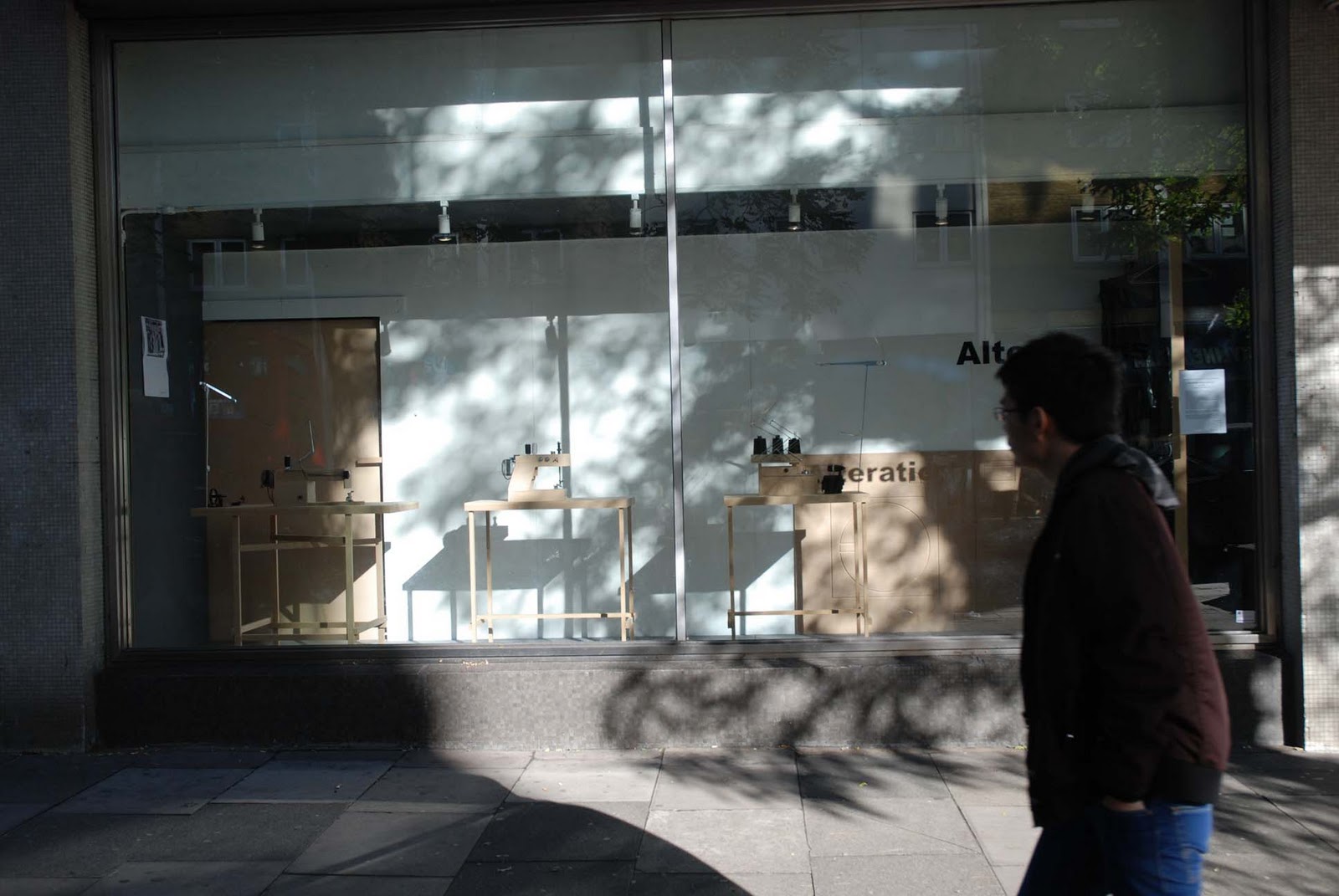
A Change of Perspective: Valentino Diego and his Alterations


When I spoke about connections, I had no idea how far this would take me in terms of artists' contacts and all the great projects that have followed. 

Ladies and Gentlemen, I give you D.V., aka Valentino Diego. A post from very long time ago gave an introduction to our MA Curating the Contemporary brand new, self managed, not credited and auto funded Window Project, affectionately nicknamed the MACC Relay.
The first of four projects opened on 13 October, in the middle of one of the craziest weeks for London's contemporary art scene - and for SybinQ Art Projects in particular - ever. 
I already knew Diego's great capability to build things. Still, I had no idea about his incredible visual talent, nor about his photographic memory. Working with him made me rediscover another notion that is not really attached to contemporary artists anymore since a very long time: being able to craft things, to create new objects with your hands, to bend the medium and give it a different meaning. 
In one word: craftsmanship.


Diego took plain MDF, some metallic bits and pieces, hangers, bin bags and transformed everything into an environment, a place with functioning objects in it. This function was given by the idea behind the installation: a fake alteration shop, a prop, trying to convince the passer-by of its authenticity. 
In the text I wrote for the display panel, I came up with the concept of the street window being the primary form of display: we look at these windows expectantly, because we're used to them offering us something we may - or may not - desire.

Once again, the intention here is to stop this process.
Every single object on display seems to shout Just stop, look at me, look at me closely, I am not what you assume I am. Don't assume: experience it. 

Yesterday it was de-installation day, and all these beautiful objects came back to be waste material. While I was carrying everything out of the space and stacking them in a safe place (I don't have the heart to just throw everything away, as the artist instructed me), I couldn't help to think: all this work, and none of this made to last. 


On my way back to the underground, I noticed a huge advertising board at London Met, made to cover the current works in progress to refurbish the studios. It reads: "See things from a different perspective".

What a coincidence.

Thursday, 26 August 2010

Window of Opportunity

Duccio Di Buoninsegna, Flagellation, 1308ca
Tempera on wood panel,
Museo dell' Opera del Duomo, Siena, Italy

Definition of "Window of opportunity" from an on-line source:
Idioms: Fig. a brief time period in which an opportunity exists.
What we see in this image is what our friend Duccio must have thought to be an incredible breakthrough in the much sought-after use of perspective in painting at that time. Like Giotto, Duccio was a pupil of Cimabue, the undisputed pioneer of the creation of the third dimension according to the biographer and first art historian Giorgio Vasari.

It was the XIV century in Italy, and religious painting was greatly influenced by Byzantine examples in which flat, uncanny figures of Madonnas with Baby floated about with no chiaroscuro in their clothes nor any shadow on the ground. In short: no sign of humanity was to be recognised in such icons representing the Divine, and the Italians did what they do best: copying, and re-elaborating in better quality. Little by little, the use of perspective opened a window of opportunities in figurative representation, bringing Gods and Saints back to reality, down from the heavenly sphere to mingle with the common people who, in turn, felt closer to them.

Now, this image nowadays makes us smile a little, because we can see that something is wrong with it: Pilate is neither inside nor outside, with his arm outstretching in front of the column; we can tell the construction of the "box" hosting the scene is weird, whereas the layers of the attending people land on no floor, like cards laid on a table. Despite Duccio's efforts, the image is still flat; it would have taken at least another century to get, for example, to this.

After all this I hope interesting stuff, you may be wondering why I have chosen this particular image and am posting this particular post. First of all, Habda was inspired by the image - during one of her visits to the National Gallery - which can be used as a tool leading to develop free interpretations of the concept  "wrong perspective". This triggered a whole series of thoughts that the other curators and I are going to develop into shows, in another window, starting at the end of September. 

Apparently, windows really are receptacles of opportunities at the moment. 

Regarding the wrong perspective, let me tell you something more: it's not that Duccio wasn't aware of the wrongness of his image; he deliberately chose to emphasize Pilate's death sentence through the gesture, even if this literally had to come out of the scene. In my opinion, this makes a huge conceptual difference. On the basis of this, what would be the wrong perspective, his or ours?

Saturday, 21 August 2010

Ausstellungsmacher

Don't worry, I am not insulting anyone in another language.
Especially in German, which is something I don't even have a smattering of. I can pronounce Oranienstraße or Ja correctly, but that would be all.


According to Harald Szeemann, the Ausstellungsmacher (translated, the vulgar "Exhibition Organiser" before the advent of the fancy word "Curator") is:

- Administrator
- Amateur
- Author of Introductions
- Librarian
- Manager and Accountant
- Animator
- Conservator
- Financier
- Diplomat

Just a German word, to summing it up so well.


Monday, 26 July 2010

Mario (a post for connoisseurs)

22 July 2010.

The Bay Window is officially turned into a light projection box. Meaning: if you happen to stroll by Cleveland street, you will bump into Luana Perilli's magnificent video.


No picture can give it justice (especially if made by me and my antediluvian camera), therefore you will need to wait that my confidence in using Final Cut increases just that tiny little bit in order to edit another video, possibly in a better way than this.

The second Bay Window Project taught me a couple of important things that other budding curators might find useful:

The first: if you are projecting a video outdoor, in London, in the month of July, check the sunset's precise time before sending the press release out. This will avoid you panicking because at 7:30 pm you can't see anything and start hoping, wishing and praying that people will arrive the usual late. Which, in fact, for once doesn't happen.

The second: no matter how big the problem is, there is always a Plan B concealed as an ingenious idea. In our case, a little monitor with the video on in the lower part of the window solved the trouble of the poor visibility and became quite performative.

Finally, the third is Mario.
Mario is the famous art critic you must know and have to have at your openings. As reserved and uncatchable as Charles Saatchi, this eminent intellectual rounds on exhibitions undisturbed and has the power to launch or demolish whoever at glance. From where his words will fall upon you, is not for you to know. If he reviews a show, no one who attended is really sure they have seen him there. Most of all, Mario is so ineffable and so incredibly famous at the same time, that there is the tendency to forget his name.

A - You know, I know that famous art critic...
B - Do you?
A - Yes, you know...he's a very famous one...you must know him! Oh God, what was his name again?
B - (encouraging) Mario?

That's it! Mario.
Mario is everywhere, and there is always a Mario for every opening. In the end, aren't we all waiting for Mario?

I would like to thank the artist, G2, my G, curator Francesca Cavallo from cosmicmegabrain, Alessia, Tati and all the others who attended the opening, making it a very nice and funny evening.

Saturday, 24 July 2010

Coffee and TV: the next Bay Window Project


Tuesday 20 July.

Italian artist Luana Perilli (pictured) is in London for the first time for her solo show in The Bay Window Project. She's been traveling a lot lately between Rome, Milan and Naples, where she is having a residency at the PAN Museum.

We talk a lot about Naples' ill famed Spanish Areas, where she is actually living: after 9 pm there is a sort of curfew and you see no one around. After a shameless questioning (who are you, what you are doing here, how long are you staying for, who do you know), the owner of the bar where she goes everyday for a coffee decided that she is "not bothering anyone. Yet."

She likes London. The first impression is what it counts: I warn her that you may love it or hate it, it seems to be a very immediate reaction for every European. Black or white, no halfway house.

Before throwing ourselves into the setting up of the next Bay Window Project, I take her around the area to do some very essential tasks: grocery shopping. Very intellectual, but my opinion is: to learn something about a new country, you must start from the food. Then, after having made sure that we weren't going to starve in the following days, we go gallery spotting, straight into London's evening life.

Our Habda is opening a show at Medcalf: Alex Heaton, with Abyssal Worpeltinger. 


After a two-weeks break from the art world, it's nice to find the soft hubbub of an opening again, seasoned with smelling-good hamburgers that are being cooked outside. We exchange impressions on the show and are quite impressed by the huge paintings representing imaginary mountain landscapes covered in snow.

Back home, we wait for our men to arrive: they have the same name, and they both are late. My G. went to a congress and the following drinks, Luana's G2 is arriving from Heathrow: "I still have 18 stops ahead!" an SMS she receives complain. We try the video on the window: tracing paper is stuck on the glass, the size adjusted, the decision to blacken the lower part of the window and to project just on the upper part made. Si Dolce e' il Tormento, the tune that accompanies and gives the title to the video, fills the room in loop. So sweet is the torment, but I would listen to it over and over again (and so will the public on the opening day, because we are leaving the sound on just for that night!) The moving objects reflect themselves in the windows of the building in front of us. Luana peeks at it from behind the tracing paper, and is happy about the effect.

People already have started to look up from the street, intrigued.


Friday, 25 June 2010

SybinQ Art Projects is born

Martin Westwood, Flat-field, 2010
Laminated print on window glazing
4 panels, dimensions variable.

Courtesy: The Artist and SybinQ Art Project
I wanted to write a post about exhibiting in a window.

The exhibition finishes in two days and I have been feeling that weird sensation of melancholy for the whole week. Being a curator can't really get so personal, but I guess it's normal: you always work on temporary projects, the shows, which are set up and then dismantled. If you do a good job, they will be remembered, mentioned, and inspire people for... ever? 
Well, at least for a very long time.

I'd like to talk plainly about The Bay Window Project now, beyond the academism of the press release. First of all, the idea was inspired by my Mum. She is not that into art, but likes to gaze-peep into other people's windows at night, when the curtains are slightly open and you can catch a glimpse of what's going on in a house different from yours. Something unavoidable, that is, curiosity. An invading tool, that makes you call yourself a voyeur with all the wrong connotations this term implies. 

But, in fact, minding people's business is licit if done through the media: the Big Brother on TV, all sorts of video on You Tube, not to mention that I am living in the most surveyed country in the world, a nation under CCTVs. The present show at Tate Modern, Exposed, is just about this. It is interesting to see what happens, instead, when the gaze is free to wonder in an urban environment. Usually the mind is blinded by personal thoughts, which make it difficult to actually register disruptions in the ordinary layout of buildings, shops, advertising signs, and so on.


This is where The Bay Window places itself, attempting to attract the passer-by gaze.
Documenting curiosity, in this case, becomes difficult. I have been observing people strolling along the street and hardly anyone is aware of their surroundings. Moreover, of the very few ones who might have raised their chin, spotted the window, and understood that they weren't looking at blinds, I know nothing of their thoughts. I would really like to hear opinions, to have crits. From "interesting" to "why would this interest me?" Art breeds on discussion, and I feel that this project, still at its embryonal state, needs some feedback.

The opening saw thirty people coming and it was nice chatting with them and hearing their impressions. I had a black notebook for the purpose, which collected, in total, two comments: one was raising an health and safety issue, the other was, simply, "Amazing project. You inspire people."

I shall add, at the end, that a new peculiar exhibition space is born: SybinQ Art Projects.
For now, it's in the Bay Window. But being not a gallery space, it can change place.

Note to the picture: since I do not have a camera with the wide angle lens, this is the result of sticking two pictures together. And yes, I took the inspiration from Digby's work, to whom I apologise for the poor result.

Tuesday, 15 June 2010

The (late) Events

All is left of the show is the orange vinyl on the door, that we forgot to remove. 

Russel Charter's installation next to it, that was blocking the view from outside, is gone too, leaving place to an exceptionally shiny window. Dylan Shipton's structure was dismantled piece by piece, several of which were just thrown away. All the other framed works, including the huge Odyssey panel, are bubble-wrapped and awaiting collection.
The plinths we recycled from the room in the basement came back to their place, one painted black, another pierced in various points with a drill in order to let some cables passing through. 
Dust, screws, plaster and a hammer.
Fresh white paint on the walls and on some tape, to try and conceal the drilled holes on the plinth.

After the hard work, nothing remains but pictures, and some mention here and there. For example, let's remember the Events before the memory fades away (musica, Maestro!)


First of all, a big thank you to Digby Washer for having taken these glorious pictures.


Digby likes to construct the picture by assembling different frames, creating elements of surprise and displacement. In this picure, Cesare Pietroiusti was just starting his talk about The Artist and the Given Space. He told us about his different experiences, as an artist, of trying to go beyond the wall, like for example when he worked for three hours to demolish a wall in a cellar during an art event in Rome. 
He though he would have found a passage to go to a garden on the other side and ended up in a private loo, instead. Behind the wall, there stood another one. Back to the talk, people interacted with him (which, in fact, is one of the points of his practice) making questions, and everyone seemed to have had a good time. We were very pleased to see, among the public, Whitechapel Gallery's director Iwona Blazwick and Documenta's curator Carolyn Christov-Bakargiev. 

The cream of the crop was, in the end, to finally see the performance Dancing on Kelkulè devised by artist Sophie Vent. 

Sophie was introduced to the show by Will and Clementina gave a description of her work in the handouts: "Dancing on Kelkulè is a live performance of the B-Endorphin molecule translated through dance. The translation derives from the chemical structure of the molecule; the skeletal diagram is re-built and represented as a physical form, translating the language and symbols of the diagram into a new system of interpretation. Vent worked alongside choreographer Jummy Bolanji & Child of Zion dance group for a new language growing up from the molecular shapes, physical properties and Kekulè's Laws."

Art and Science. Again.
So, how does a molecule behave then? It jumps, up and down. It changes direction quite suddenly, it tries to mingle with the other ones without succeeding. It wears quite a serious face, it knows what its job is and can't get distracted. What does it transmits? Energy. Pure energy.

To conclude with Thank Yous, hail to the participating dancers and their coreographer: Arinthia, Jummy Bolaji, Ta’Shanh Clarke, Jaigh Ejakpovi, Davida John, Abraham Kanu, Santhy Sivananthan.

Saturday, 1 May 2010

Activities (and Inactivities)

The picture here is a little homage to Jannis Kounellis

Hello. Minus eleven.

Things have been sorted before this forthcoming bank holiday, so we are ready to take what is coming next week.

Silvia Iorio has arrived and, with her, arrived the switches. That is just one in a hundred and something, still to be painted. It is quite exciting to see bits and pieces of a work before it is set into place, which should happen at some point next week.
We've been talking to technicians for a big plywood panel to host them in the final installation, arranging dimensions and even granted a studio for Silvia where she will be able to assemble the work.
Can't wait to see it finally in place. Check.

Not only the mailer, but also the lovely catalogue and postcards have been sent off last Wednesday via post. People should receive it just after May Bank holiday. Time Out has been alerted about the show on Tuesday night, just one day before the deadline for the listings.
Check.

Charlotte's work is on the way. Really looking forward to seeing it as it is very small and intimate. We'll probably find it in our office when we go back to work on Wednesday. Check.

Martina and Nathalie should have their work ready too and will bring it in next week at some point, very close to the opening. We have a nice scale model of Unit 2 in our office made by our Francesca and had spent the latest weeks arranging mini-artworks mock up around. We seem to have very straightforward ideas about the hanging. Check.

Some very nice vinyls of the show's title and dates are being ordered by Habda for the door. Not in England, because they're too pricy, but from abroad. They should arrive just on time, unless another volcano blows up. Check.

Russel is probably buying the white wash paint for the window in this very moment, whereas Silvia is hunting for spray paint and varnish around Soho, with a map in one hand and some more switches in the other. Check.

Dylan and Sophie have been in touch, too. Their work will be a nice surprise. Katja and Gusztav are coming from Berlin for the opening with all their family: thanks again to the Goethe Institut for their support. Check.

Cesare didn't let me know if he needs a projector for his talk. Eeek!

Friday, 9 April 2010

Carmen Queasy

When you are not a native speaker, language misunderstandings happen. 

For example, I wanted to start this post with some lyrics from the song Carmen Queasy from Skunk Anansie + Maxim because I thought the words were: Money making this wonderful things. Having not completely understood the lyrics, I have imagined that Skin was listing some nice things you can have because of money, but in a rather pillory way. Quite the opposite, as the correct phrase is: Money making is a wonderful thing. 

I smiled to myself when I thought that it is exactly what doesn't happen to the dark side of the Art World, the side behind the scenes, that of the curators. 

The show is going rather well. We have even written our texts for the catalogue, that, after long consideration, will be a nice constantine (constantine?!? You mean concertina...) instead of a booklet, because the latter was too expensive. We are bringing in some artists from abroad, and this weights considerably on the budget, so we had to cut out a bit on the catalogue. A necessary sacrifice? Who knows, I guess we'll only discovery it after the opening. The concept of the space is finally developed, and each artist's work that we selected seem to get well with it. 

But. 
At this very moment, I think about myself as calm and queasy. Yes, call me Carmen. 
Some of you may remember this post and our encounter with lovely Silvia Iorio. Her interesting work, based on the entanglement theory, is turning out to be rather complicated to do for this particular contest of an MA curating student show. I would say that money is the main problem, but someone would surely retort that you can indeed organize a great show with very little budget.
I would like to reply then thinking about the words of Hans Ulrich Obrist: in this job, mistakes happen, and they are very welcome. I take it this is it, but I am still hoping we can run with the hare and hunt with the hounds. In short: we really want Silvia in the show, but still need to understand how.

I think I have got a twitching eye...

The elusivity of this post is deliberated, as the complete technical description of Silvia Iorio's new work cannot be divulgated. Yet.


Friday, 2 April 2010

How about some advice?

I have read with great amusement this recommendations to a budding curator by the self confessed newspaper man Augustine Zenakos, who in turn was suggested to us by the curator Tom Morton. I couldn't resist but leaving some personal comments.

Read a lot of post-structuralism, preferably in the form of quotations you can find in catalogue essays. Quote them in turn, profusely, making sure their relationship to any actual artwork remains obscure.

Whenever I see the word "post-structuralism", I just turn the page over.

No studying anything before the 1960s is allowed. Learn all your history through contemporary art theory.

I tried that, but my heart belongs with the idea that history, all history, is necessary to do a good job.

Never say you are anything more than a facilitator for artists. If inadvertently you do, and you momentarily appear like having anything remotely resembling a vision or, worse, an agenda, cover it up quickly with a phrase like “curators have to stand firm against the voracity of the market”.

Yes, Master.

Be as immaterial as possible, be a ghost. Support everything anti-spectacular and insubstantial. When asked to describe it, use words like interventional, process-based, archaeological, investigative. If challenged with something like the inability of others to see the point, call them antiquated and formalist and declare the work of art to be changing.

You forgot to include "taxonomy" in your list, Master.

Praise the local, but in abstract terms. Make sure that you choose a local thing that does not require any local knowledge to be understood. If you can’t find something suitably local where you are, pick a Mexican or a Lithuanian one. When faced with a situation that is truly local, dismiss it as nationalist, and continue.

But this will cut any potential fund out, Master.

Be against state-run cultural policies, as well as private enterprise. Declare your support for small autonomous zones of collaboration. When asked about their funding, don’t dwell too much: this is not about money.

And the fact that it is never about money makes the curator zone off limits for those who can't afford it, which is a shame.

Be for independent organizations, but when faced with one, call it cliquey and turn away. There is nothing there for the taking, anyway.

Er...Yes, Master.

Always acknowledge the public. Say that all this is being done for their benefit, because contemporary art is for everyone. Then, blame lack of funding, public support, etc. If someone appears to be practical about these things, call them a behind-the-scenes-mover-and-shaker and state that you are not interested in authoritarian structure.

Wow, I never thought to actually be such a complicated thing. I just thought I was practical.

You’ll do fine.

Thank you, Master.

And now, let's close the little distraction-from-the-more-important-task-of-writing-the-damn-catalogue-text-for-our-show-post and go back to work.

Saturday, 13 March 2010

The Kite Flyer


Sometimes thoughts just strike at 8:30 in the morning.
I was thinking over the relationship between curator and artist just in front of the bathroom mirror and came up with this conclusion: a curator is like a kite flyer.

I like the idea of the artist as a kite: they like to fly free, beyond imagination, and sometimes above reality. If there wasn't that tiny string linking them to a flyer, they will get lost. Or crash on a tree. Or smash to the ground when the wind stops blowing. On the other side, the curator leads the kite, guides it, but cannot totally control it. Even pulling the string doesn't guarantee the kite to follow the instructions; it may start turning, twisting and flipping, because the wind is too strong. And paying it out too much string may bring the kite to fly too far away, and eventually fall. Sometimes, kite and kite flyer found themselves stuck: when there is no wind, no matter how hard they try. When the kite gets stuck to a tree, and the kite flyer somehow has to rescue it, trying to minimize damages. Sometimes, the kite would surprise the kite flyer by doing unexpected acrobatics, things that happen by chance and can only be repeated through experience, time, trial and error.

That's a very special, complicated relationship, based on a delicate equilibrium. The string that unites them doesn't mean subordination, for any of the two. It's about working together and be able to fly high without falling. Kites and artists are very fragile, and sometimes curators and kite flyers are inexperienced. But all can be fixed, including flying skills and torn paper, if they learn to trust and support each other.