Showing posts with label Martin Westwood. Show all posts

Thursday, 5 August 2010

The Bay Window Project: Martin Westwood


A new exciting project space is opening in Fitzrovia, but this time it's not another commercial gallery.

THE BAY WINDOW PROJECT
Six Artists in a Frame
curated by sybin


OPENING: Wednesday 9 June at 6:30 pm
Until Sunday 23 June.

SybinQ Art Project
The window on Cleveland Street
London W1T 6NW

Tube: Great Portland Street
(the window is visible when Cleveland St meets Carburton St)

Information: sybin@inwind.it

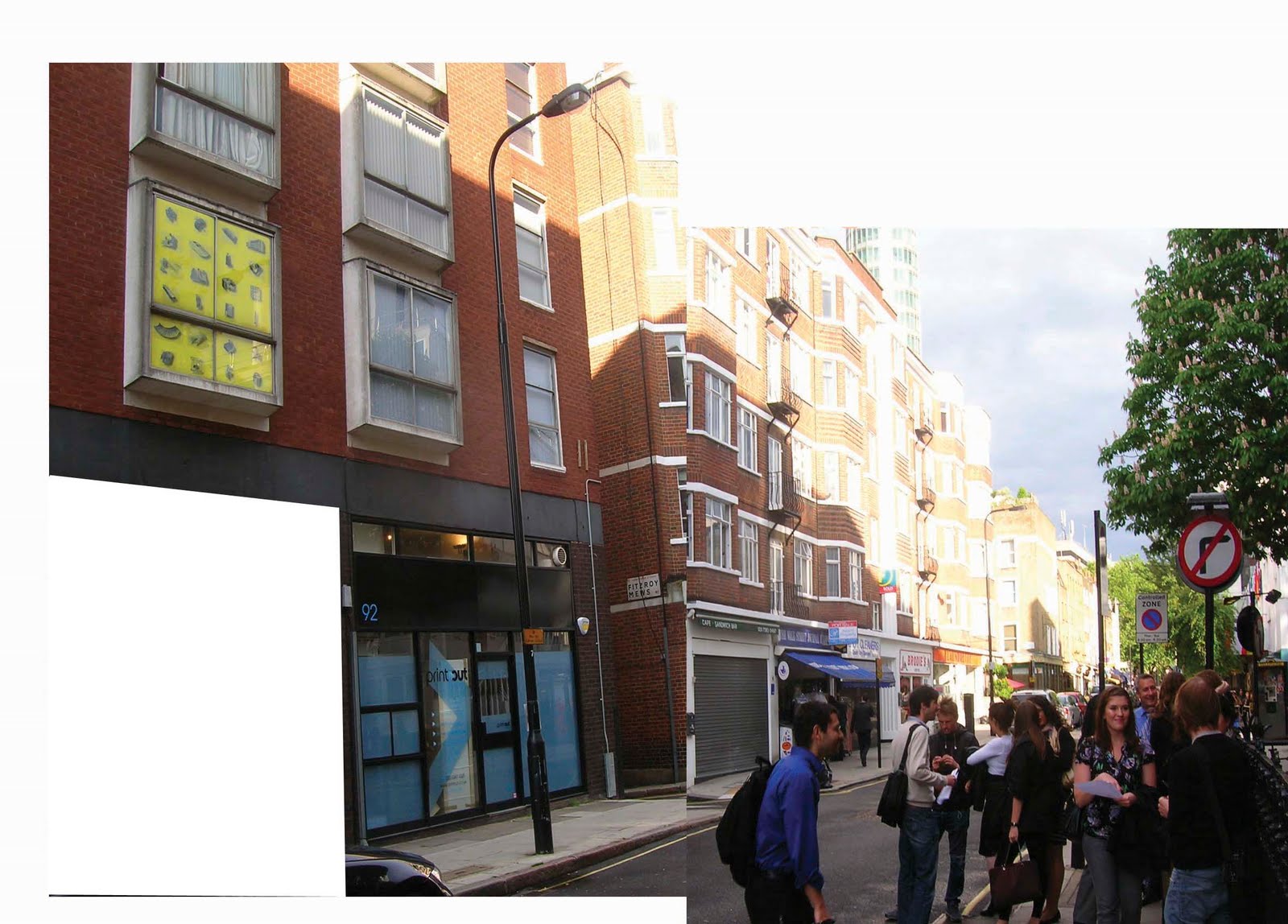
A private residence with tenants. A square bay window that overlooks the street, looking like a huge frame hanging on an anonymous building’s façade. When the curtains are open, from the street it is possible to gaze - peeping inside other people’s home and lives. Derived from its shape and meaning, the bay window has been designated as a functional place, like a white cube – to host art. This unusual, limited space (193 x 180 x 60 cm), is offered to six artists to create, one after the other, a site-specific works, which will engage with the concepts of home and gallery, private and public, gaze and voyeurism, disruption and continuity.

sybin is a young curator based in London and interested in supporting young and established artists, especially through the creation of peculiar show settings outside the so-called normal exhibition parameters. One interesting aspect about this is being able to bring art into the street, like an open-air gallery, for every passer-by to enjoy. SybinQ Art Project is a not-for-profit organisation aiming to create networks and sustainable conditions for the commissions of new artworks.

The first artist invited to exhibit in The Bay Window is MARTIN WESTWOOD
(Born in Sheffield, 1969. Lives and works in London).

Martin’s projects investigate the state of contemporary society, with a recurring focus on themes of bureaucracy, commerce, economy and corporate culture. He created complex systems of codes and symbols that incorporate and reference familiar objects – suspended ceilings, watercoolers, chequebooks, promotional balloons, invoice sheets - artificially decomposed and then reconstructed. His artworks vary in scale and format from large installations to paintings and multi-layered collages.

For The Bay Window Project, Martin is presenting Flat-field, a work which takes inspiration from the social relations we experience every day. The eye is captured by the bright background, on which different images, deprived of their three-dimensional status, are reduced or enlarged to the same size. The viewer can recognise objects, details, places and situations we are so familiar with that we experience them almost automatically. The street, the advertising signs, the private dimension of the window switching to public: everything constitutes a hierarchy of objects that the artist is trying to disassemble and analyse on the base of the Actor Network Theory (ANT) studies. Developed, among others, by Bruno Latour, ANT is a branch of Sociology trying to map relations that are at the same time material (between things) and semiotic (between concepts), and tries to understand how certain relations (networks), which imply human interaction with inanimate things, are formed and kept. If a network ceases to work, each single element in it can be examined and re-interpreted: as Latour puts it, speaking about Pandora's Box, when closed it is perceived as a box, whereas when opened the elements inside are visible. It is about communication, the messages we give and receive in the working and private dimension, the signs we interpret and how unwittingly we relate to all of it, performing our social interactions over and over again to avoid our created network to dissolve. This is the artist's aim in The Bay Window to present a flattening out of the hierarchy that organises social relations, to suggest a suspension of the performance of the social.

Part of The Bay Window Project is also the creation of The Fitzrovia Map, which will be available on line soon and highlight places of interests in the area, from the famous art galleries to the less known landmark buildings, from fancy restaurants to interesting shops.


Take a stroll with your nose up!


Next: LUANA PERILLI in July.

Saturday, 31 July 2010

Wicked. A nostalgic bohemian feeling

Yesterday, Hackney Wick opened its doors, and artist's studios doors, to the other side of the world for a three-days art festival. 

For a non-English mother-tongue obsessed with grasping every nuance of words' meaning, the name of the festival is a delightful and clever language game, swinging between "cool" and "bad": wicked. Very appropriate, if you consider that, as soon as you get off the overground, in normal days you would find yourself in the middle of nothing. Instead, the industrial and unattractive buildings (which, in fact, I find fab) are studios and homes for a large community of artists.

It feels like landing in another world, which you have to explore just with the aid of the - few - tools in your possession (a map of the area highlighting the main events' location) and a good dose of interpersonal skills, especially in  matter of orientation. The territory is not hostile of course, but you do feel like an outsider and start following the other +people, who know exactly where to go, like a stalker.

The many events were just unfolding around us, we could hear some music and percussion coming from the train station exit, and we had just missed our place at the dinner/performance organised by the curatorial collective Cosmicmegabrain. I just had the time to see one of the curators rushing to the terrace in Oslo House, wearing a shiny yellow foil hat with some flowers and cherries sprouting out of it. This is what I call landing on the job. After having bumped with pleasure in the only artist I know in the area (Martin Weswood, ndr), Habda and I ventured to see the studios and some art in the making. That was when I had the bohemian attack.


Known also as the Late Bohemian Sindrome, this rare and unlikely illness strikes subjects who are particularly sensitive to large, loft-like spaces, possibly with mezzanines, where art, great second-hand furnishings and private life are equally mixed. The first symptom is that the mind starts to wonder, imagining night parties like sin and a continuous, often stimulating confront with your neighboring peers. The attack carries on with drooling, a good dose of envy, loads of mental notes like the-day-I-will-have-my-own-house-I-must-remember-this-arrangement and, finally, it quickly fades away with the very down-to-earth thought: "But there is a common loo. No shower." The bohemian feeling lingers, though. The idea of something going on which maybe won't lead to the next generation of star artists to be born, but it will certainly be a tale to remember and tell: When I was twenty, I had a studio in Hackney Wick which I transformed into a living unit. I was painting everyday and partying every night - or the other way round -, we would talk a lot about art with the others and sometimes young critics and curators would join us. We organised shows and events, made things happen and... All right, I'll come off it.  It just made me think that all the famous artists and curators we know must have started like this: with a beer, a romantic kennel and a good chat. That's what they must still be doing, actually.

Moving on, we managed not to miss Roberto Ekholm's performance The Magnetic Man inside the show La Perruque: inspired by Michel De Certeau's writings around cultural practices and relationships, the show tries to manipulate commonplaces and make them habitable, which is to say, to use your own creativity space into the rigid and framed working society.

The evening was concluded with a quick - rainy - shower and my venturing up an emergency iron ladder to go to one of the building's roof and have a glance at the city landscape. On the other side of the river, the Olympic Village is taking shape and I couldn't help but wonder what will it be of these guys once this is turned into a fashionable residential area. Below, lights were glowing from the opened spaces, with people milling around, commenting the latest works. Looking down, De Certeau sprung to mind again for his most famous writing about the practice of everyday life (1984): the city seen from above is the result of the institutionalised bodies, who organise it in a grid and try to direct the experience and gaze of the person traveling in it. Below, people continued to get lost or get rid of the map, following their instinct instead, enjoying the dérive.


Friday, 25 June 2010

SybinQ Art Projects is born

Martin Westwood, Flat-field, 2010
Laminated print on window glazing
4 panels, dimensions variable.

Courtesy: The Artist and SybinQ Art Project
I wanted to write a post about exhibiting in a window.

The exhibition finishes in two days and I have been feeling that weird sensation of melancholy for the whole week. Being a curator can't really get so personal, but I guess it's normal: you always work on temporary projects, the shows, which are set up and then dismantled. If you do a good job, they will be remembered, mentioned, and inspire people for... ever? 
Well, at least for a very long time.

I'd like to talk plainly about The Bay Window Project now, beyond the academism of the press release. First of all, the idea was inspired by my Mum. She is not that into art, but likes to gaze-peep into other people's windows at night, when the curtains are slightly open and you can catch a glimpse of what's going on in a house different from yours. Something unavoidable, that is, curiosity. An invading tool, that makes you call yourself a voyeur with all the wrong connotations this term implies. 

But, in fact, minding people's business is licit if done through the media: the Big Brother on TV, all sorts of video on You Tube, not to mention that I am living in the most surveyed country in the world, a nation under CCTVs. The present show at Tate Modern, Exposed, is just about this. It is interesting to see what happens, instead, when the gaze is free to wonder in an urban environment. Usually the mind is blinded by personal thoughts, which make it difficult to actually register disruptions in the ordinary layout of buildings, shops, advertising signs, and so on.


This is where The Bay Window places itself, attempting to attract the passer-by gaze.
Documenting curiosity, in this case, becomes difficult. I have been observing people strolling along the street and hardly anyone is aware of their surroundings. Moreover, of the very few ones who might have raised their chin, spotted the window, and understood that they weren't looking at blinds, I know nothing of their thoughts. I would really like to hear opinions, to have crits. From "interesting" to "why would this interest me?" Art breeds on discussion, and I feel that this project, still at its embryonal state, needs some feedback.

The opening saw thirty people coming and it was nice chatting with them and hearing their impressions. I had a black notebook for the purpose, which collected, in total, two comments: one was raising an health and safety issue, the other was, simply, "Amazing project. You inspire people."

I shall add, at the end, that a new peculiar exhibition space is born: SybinQ Art Projects.
For now, it's in the Bay Window. But being not a gallery space, it can change place.

Note to the picture: since I do not have a camera with the wide angle lens, this is the result of sticking two pictures together. And yes, I took the inspiration from Digby's work, to whom I apologise for the poor result.