Showing posts with label Discussion. Show all posts

Thursday, 19 August 2010

Performance Anxiety

Wednesday the 18th. Opening day.

I must confess I use the old trick of "No Great Expectations" to survive the evening, which is also called common sense: if you have just started an exhibition project in a city that is not your birthplace, which is to say where you don't know a huge amount of people, then if five souls show up at your openings you may consider it a success.

It's 6:30 sharp. I am in Cleveland Street, opposite The Bay Window, leaning on my own on the iron fence. The work by Salvatore Mauro is in place and looks great: a series of different photographs, arranged in repeating patterns, of a girl holding some shower hoses behind her neck. Gossip detail: I have asked the artist to remove the bit in which a glimpse of the girl's breasts appeared. I didn't want to have any "moral order" problems with neighbors, passers-by or parents: in the end, The Bay Window is not a private gallery, it's a sort of public space. Moreover, its function is not hundred-per-cent clear: I bet some people must think that who lives in that flat has a very strange taste for fancy curtains.

I am holding a bunch of home made flyers, the latest idea in matter of promotion. Word document, printed and cut in half. I am going to hand them to people strolling by and just try to inform them about what is going on under their noses. Normally, I wouldn't have any problem in approaching total strangers on their way home to harass them about an art project: my latest cheeky deed was smiling at Noel Gallagher like he was an old friend of mine while we crossed paths on the street for the second time. He nodded back, bless him.

Well, back to the flyers, at the beginning I just can't do it. It's very different when you have to face people concerning a project of yours: there is no distance from it to save you, you're just too much involved. I think we can call it "performance anxiety" and it comprises several factors, including still being on my own on a street at 6:42 pm on an August Wednesday evening. OK, everyone shows up late at the openings (Ah, really?), but what if no one comes this time? I lift a flyer, looking hopefully at a man in a suit approaching. He snatches it absentmindedly and mutters a thankyou.
"No no, thank YOU", I hurriedly say. I start observing people's behavior, the unmistakeable don't-nag-me signs: a girl leaves the pavement and walks on the road to put the maximum distance possible between me and her. Come on, darling, it's just a flyer... it doesn't bite! Other people just say NO and walk away. It's normal, I would probably do the same, but frustration starts to arise. Flyers apart, no one has really noticed the window.
For a split second, this is what I think: Why the hell did I do that? I just want to go home. 

That's when people start to arrive. One in particular is my hero: my G., who is my partner in crime and supporter for this project, handles the flyers much better than me (and he claims to be a shy person). The people coming to see the window are all acquaintances of mine, and what pleases me is seeing new faces in addition to those who can be called the regulars (two, in fact). Chattering and explanations begin, with other people briefly stopping. A smiling lady approaches us from the restaurant on the other side of the road to ask what this is all about. She grabs a flyer, looses it to the wind and goes fetching it again.
Among the small public there are three curators and two artists, the ones with whom you can have a serious talk later on at the pub.

Artists always speak their minds, which is much appreciated: one in particular, after my explanation about the meaning of the presented work, says that in his opinion the work fails to convey such message and that maybe this time the choice isn't exactly appropriate for the window (I knew! I knew the images were too small! I knew...). Habda, who is there too, asks him in what way and I know she won't let go until she has a straightforward, satisfying answer. I like her way of digging into things. After a good deal of "er" and "hum", the artist replies: "I don't really know..."

Salvatore Mauro, Intimate Parallelism, 2010
Plotter print, 4 panels on window glazing, dimensions variable.

Courtesy The Artist and SybinQ Art Project

Before going home at 9:30ish, G. and I are approached by P., restaurant owner and participant observer of The Bay Window Project since they are one below the other.
P. is a very very nice man, and he tells us that, while we were at the pub, a bloke showed up to see the window and was quite frustrated not to find anyone; he also complained to P. about the difficulty of finding the place. In short, he was disappointed.

I am wondering who this is, or, perhaps, if he was Mario.

Saturday, 31 July 2010

Wicked. A nostalgic bohemian feeling

Yesterday, Hackney Wick opened its doors, and artist's studios doors, to the other side of the world for a three-days art festival. 

For a non-English mother-tongue obsessed with grasping every nuance of words' meaning, the name of the festival is a delightful and clever language game, swinging between "cool" and "bad": wicked. Very appropriate, if you consider that, as soon as you get off the overground, in normal days you would find yourself in the middle of nothing. Instead, the industrial and unattractive buildings (which, in fact, I find fab) are studios and homes for a large community of artists.

It feels like landing in another world, which you have to explore just with the aid of the - few - tools in your possession (a map of the area highlighting the main events' location) and a good dose of interpersonal skills, especially in  matter of orientation. The territory is not hostile of course, but you do feel like an outsider and start following the other +people, who know exactly where to go, like a stalker.

The many events were just unfolding around us, we could hear some music and percussion coming from the train station exit, and we had just missed our place at the dinner/performance organised by the curatorial collective Cosmicmegabrain. I just had the time to see one of the curators rushing to the terrace in Oslo House, wearing a shiny yellow foil hat with some flowers and cherries sprouting out of it. This is what I call landing on the job. After having bumped with pleasure in the only artist I know in the area (Martin Weswood, ndr), Habda and I ventured to see the studios and some art in the making. That was when I had the bohemian attack.


Known also as the Late Bohemian Sindrome, this rare and unlikely illness strikes subjects who are particularly sensitive to large, loft-like spaces, possibly with mezzanines, where art, great second-hand furnishings and private life are equally mixed. The first symptom is that the mind starts to wonder, imagining night parties like sin and a continuous, often stimulating confront with your neighboring peers. The attack carries on with drooling, a good dose of envy, loads of mental notes like the-day-I-will-have-my-own-house-I-must-remember-this-arrangement and, finally, it quickly fades away with the very down-to-earth thought: "But there is a common loo. No shower." The bohemian feeling lingers, though. The idea of something going on which maybe won't lead to the next generation of star artists to be born, but it will certainly be a tale to remember and tell: When I was twenty, I had a studio in Hackney Wick which I transformed into a living unit. I was painting everyday and partying every night - or the other way round -, we would talk a lot about art with the others and sometimes young critics and curators would join us. We organised shows and events, made things happen and... All right, I'll come off it.  It just made me think that all the famous artists and curators we know must have started like this: with a beer, a romantic kennel and a good chat. That's what they must still be doing, actually.

Moving on, we managed not to miss Roberto Ekholm's performance The Magnetic Man inside the show La Perruque: inspired by Michel De Certeau's writings around cultural practices and relationships, the show tries to manipulate commonplaces and make them habitable, which is to say, to use your own creativity space into the rigid and framed working society.

The evening was concluded with a quick - rainy - shower and my venturing up an emergency iron ladder to go to one of the building's roof and have a glance at the city landscape. On the other side of the river, the Olympic Village is taking shape and I couldn't help but wonder what will it be of these guys once this is turned into a fashionable residential area. Below, lights were glowing from the opened spaces, with people milling around, commenting the latest works. Looking down, De Certeau sprung to mind again for his most famous writing about the practice of everyday life (1984): the city seen from above is the result of the institutionalised bodies, who organise it in a grid and try to direct the experience and gaze of the person traveling in it. Below, people continued to get lost or get rid of the map, following their instinct instead, enjoying the dérive.


Friday, 25 June 2010

SybinQ Art Projects is born

Martin Westwood, Flat-field, 2010
Laminated print on window glazing
4 panels, dimensions variable.

Courtesy: The Artist and SybinQ Art Project
I wanted to write a post about exhibiting in a window.

The exhibition finishes in two days and I have been feeling that weird sensation of melancholy for the whole week. Being a curator can't really get so personal, but I guess it's normal: you always work on temporary projects, the shows, which are set up and then dismantled. If you do a good job, they will be remembered, mentioned, and inspire people for... ever? 
Well, at least for a very long time.

I'd like to talk plainly about The Bay Window Project now, beyond the academism of the press release. First of all, the idea was inspired by my Mum. She is not that into art, but likes to gaze-peep into other people's windows at night, when the curtains are slightly open and you can catch a glimpse of what's going on in a house different from yours. Something unavoidable, that is, curiosity. An invading tool, that makes you call yourself a voyeur with all the wrong connotations this term implies. 

But, in fact, minding people's business is licit if done through the media: the Big Brother on TV, all sorts of video on You Tube, not to mention that I am living in the most surveyed country in the world, a nation under CCTVs. The present show at Tate Modern, Exposed, is just about this. It is interesting to see what happens, instead, when the gaze is free to wonder in an urban environment. Usually the mind is blinded by personal thoughts, which make it difficult to actually register disruptions in the ordinary layout of buildings, shops, advertising signs, and so on.


This is where The Bay Window places itself, attempting to attract the passer-by gaze.
Documenting curiosity, in this case, becomes difficult. I have been observing people strolling along the street and hardly anyone is aware of their surroundings. Moreover, of the very few ones who might have raised their chin, spotted the window, and understood that they weren't looking at blinds, I know nothing of their thoughts. I would really like to hear opinions, to have crits. From "interesting" to "why would this interest me?" Art breeds on discussion, and I feel that this project, still at its embryonal state, needs some feedback.

The opening saw thirty people coming and it was nice chatting with them and hearing their impressions. I had a black notebook for the purpose, which collected, in total, two comments: one was raising an health and safety issue, the other was, simply, "Amazing project. You inspire people."

I shall add, at the end, that a new peculiar exhibition space is born: SybinQ Art Projects.
For now, it's in the Bay Window. But being not a gallery space, it can change place.

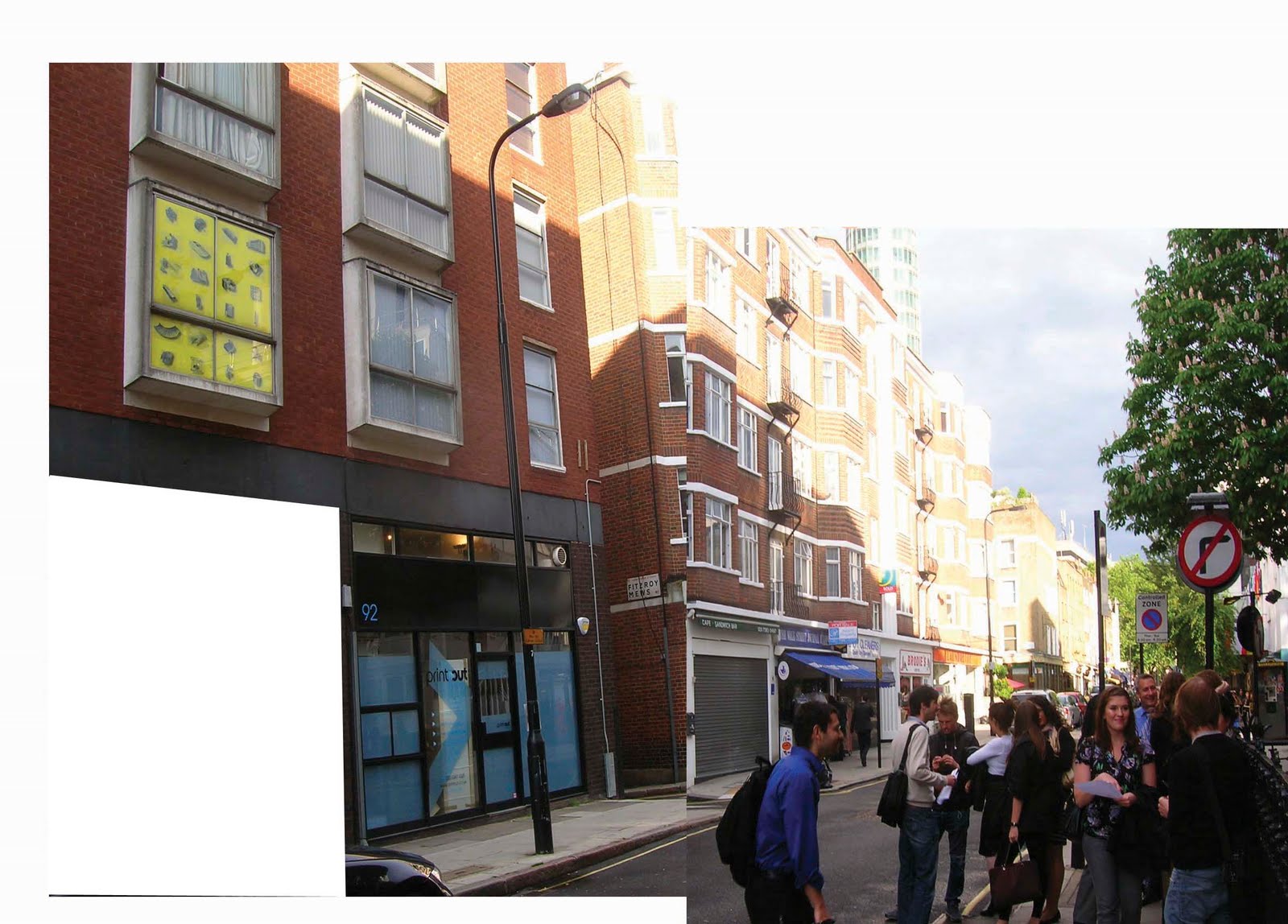
Note to the picture: since I do not have a camera with the wide angle lens, this is the result of sticking two pictures together. And yes, I took the inspiration from Digby's work, to whom I apologise for the poor result.

Saturday, 20 March 2010

First Meeting: where we stand


I know, it is a bit too late for this since we had our first meeting...hum...two weeks ago now! But, as you might have perceived by now, I do like blogging and would like this experience to remain somewhere, even lost in the internet's mesh.

It was the 10th March, a grey afternoon, when this show finally took on some kind of definitive form, which now needs to be adjusted, polished or even reviewed. We went to The Big Chill Bar on Brick Lane, perfect if you are on a tight budget but nonetheless need something to eat to get the brain spinning. Maybe we had no idea that we were to spend all the afternoon there. The first point of the meeting was: which artists do we want and why? And there, our coherence of selection finally showed: five different heads came up with eight/nine very different artists who, thought, share similar concerns about the identity of the space we are trying so hard to nail down.

We started considering Unit 2's space in particular as active/inactive: show/no show; like a brain in a body and its various connections, a mental space. This clicked with Sophie Vent's practice of mapping: a map is a type of space, a way of setting boundaries and crossing them. She will identify a map of the endorphin when it's released in the body and then translate it to a dance with the collaboration of a choreograph. Will thinks her idea to have the choreography danced by children and filmed on video is great. Going on on Unit 2, we already said that the access is restricted: the gates will be opened during the opening, but then only people with budget will be admitted in. So one question might be: who is actually going to see the show? That's when Russel Chater steps in: he is "seeking to explore spaces and states that are in between or beyond". He will cover the window with a white element used to cover derelict spaces, blocking the view from outside. During the opening, people will be invited to draw or write on it, leaving a trace on this temporary space and, most important, allowing people from the street to peek into the gaps and take a glimpse of the space. Habda also proposed other two artists, Charlotte Bracegirdle (whose practice is already explained here) and Nathalie Guinamard: with her, we enter the realm of displacement; she works with collage, selecting unaltered sections of interiors and exteriors and seeing how they work in juxtaposition: spaces in between become even more important than the visible space itself; perhaps she will work on what she'll see in-between Unit 2, and we'll hopefully discover new connotations.

Although her work will certainly be the most complicated to install, Silvia Iorio is still up with her switches installation, described here. The lamp bulbs will be all outside Unit 2 and, apart from some that we'll try to keep visible, when someone presses the button imagination will take the lead to identify where a lamp bulb is actually going on and off. Light will cross the space's boundaries, showing it for what actually is: infinite. The space as interface, meaning point of interaction, is represented by the video artists Katja Pratschke and Guszstav Hamos, whom Francesca met at the Tate. It may seem that the body and its connections are the protagonists again, but in this case it is the space of the video as a medium that is questioned through the display of still and moving images. Last but not least, Martina Geccelli, sniffed out by Clementina. A German artist with an Italian name, Martina works with photography in connection with architectural and sculptural conditions. She shoots everyday, banal objects like books or cardboard boxes to show their often hidden relationship. We all liked very much the picture of two cardboard boxes arranged upside-down, holding up in a precarious balance enhanced by their almost touching flaps. Another kind of space, defined by its limitations, the physical outlines and that in between.

Wow. A lot of concepts have been dished out here, but personally I see no discrepancy between our artists. I see something that has just started to build up. Now we would need someone authoritative, a dead or alive critic, with a strong "space" concept to place at the beginning of the critical text, in order to convince us all that this is the right track.
Isn't it?