Showing posts with label Language. Show all posts

Monday, 31 October 2011

A Story that Never Ends: How it Happened that I Joined The Piracy Project

I am going to tell you a secret.
Come closer, for I will say it softly and never repeat what I said again. My words might melt like fresh snow in the sun; they will be as fragile as isinglass, as slippery as images forming into water ripples. One moment they are there, and suddenly they are gone. You will never remember what you saw.
So, listen carefully, for I am about to tell you of a story that was forgotten, that got lost between the lines. The lines of another story. One, I am sure, you already know.

These are a character's words.
Perhaps one, or two, or none of you might remember this post and my confuse babbling about "characters kidnapping" or "destroying" me. Well, at least now you will have an explanation - and a reassurance that my mind is still here and I need no rehab. Possibly.

Everything started in February this year when I had a chat with artist Eva Weinmayr, whose studio I was visiting with one of the MA course mate. She told me about AND Publishing and The Piracy Project, something she was working on with other people in order to save a library from being shut down because of politics' recent measures of austerity. And here I can't help but wonder why it always has to be creativity and entertainment that are deemed useless in a time of crisis? What a question.
Anyway, Eva illustrated to me the joys of being a Pirate.
The Library she and her crew put together is a very peculiar one, as it is made of books that deliberately infringe copyright laws. Not just illegal reproduction of books, which is an already developed phenomenon in emerging countries where books aren't always available. We're talking about emerging authors beginning to interfere with the content of "closed" - or rather, "complete" - literary works. Borrowing here or there. Improving. Changing. Erasing.
Suggesting a different interpretation.
Using literary material, or the object-book itself, as a ready-made. Period.

"Have you ever read a book twice? Books change, every time you read them." 


And so it happened that I confessed.
I told Eva that, when I was about twelve, I took my favourite book of all times and re-wrote part of the story, inserting a new character in it. This meant copying entire paragraphs from the original book and just slid additional ones in, without changing anything too much. Like an improved clockwork or the falling bricks in Tetris, the two parts ended up matching. However, nobody ever read that because I thought it was a subtle form of stealing. You know, using someone else's characters to make up a story within a story...
'Sounds great!' Said Eva. 'We are calling for contributions.'
'Splendid!' I replied, in my boring academic English. 'There's just a tiny little hitch.'
'What is it?'
'The story is written in Italian.' I explained.
'Oh. That's fine, we're also interested in the issues of language...'
'But I can translate it.' I said, not knowing what I was getting myself into.

Back home in Rome, I dug into my personal belongings until I found the manuscript, buried under a pile of photocopied books from college's times. The plastic spiral binding holding it together showed its age signs by falling off bit by bit whenever I tried to turn a page. I recalled writing it using one of the first Macintosh computers, one as huge and square as an old telly and with the coloured apple emblazoned on it. That meant that the original file surely is lost forever, or perhaps saved on a God-knows-its-current-whereabouts floppy disk.
The story is written in two colours; green for the parts taken from the original book, red for those that I added. On the cover, printed in a curvy font that is no longer listed in Word, the title sits floating on white background in the middle of a frame-like square: A Story in The Neverending Story.

Now, there are lots of people out there who unconditionally love that book, The Neverending Story, by Michael Ende. Me being one of them.
I am sure you know the story or have at least seen the movie(s). Ende managed to write one of those evergreen masterpieces that stay with you even long after you have turned the last page. Not to mention the unforgettable characters in it. Heroes and villains so poignant you almost believe they are real.
But another reason for the book's popularity is that many stories in it are left unfinished, with the author unofficially inviting you to take over and continue - not finish, them. So I hope you will forgive me, Mister Ende, for starting a new story within your book.
It's just that there is a hidden character there, just under the reader's nose. She is like a silver shadow, a whisper between the pages, the secreted song at the very end of a CD.
All I did was just helping her come to life.
However, all a character is made of is just ink on paper, therefore her existence begins, and ends, in the space of a eighty-something pages. She is part of the story, yet she isn't. But if her story will ever be read, you will understand why it was worth writing it.


You are now looking at the final result, once the - not easy - task of translating was done. I have even involved an artist friend who, after having read the story, kindly agreed to illustrate it.
The result is so amazing that I have to show you some more:

Who doesn't want to ride a Luckdragon? 

The Ivory Tower. As you have never seen it.

All watercolours are by lovely Marianeve Leveque.
Also, I pleaded in two languages to other people to have a look at the unmistakable mistakes, and help me correct them. Well then, if I have managed to spark a little of your curiosity and you want to know what this story is all about, or want to learn what other Pirates created, you will have to chase up The Piracy Project Library, currently touring around the world.


I look at the picture of my little manuscript, figuring among more illustrious entries on the Piracy Project on-line catalogue, and smile. It is a great satisfaction indeed to finally seeing it making sense in this new dimension.

Tell me now, my friends: what is your favourite story of all times? 

Thursday, 29 September 2011

New Art Criticism_01_December 2008

New Art Criticism is no longer on-line, therefore I thought to copy and paste my contributions to the former website here. It is mostly exhibitions reviews and I hope you will enjoy the reading!


PLAYING GAMES WITH LANGUAGE: KATE STREET SOLO SHOW AT NETTIE HORN

Wandering and rummaging about which show was worth reviewing in this cold winter, I must admit that the only spotting of the Nettie Horn website made me decide to come and see this one: the small, pixel-made images were showing drawings beautifully made, with what I call a superhuman skill to make the pencil strokes disappear in a foggy, perfect sfumato.

It looked like a plant in a drawing you might well see in a Victorian botanical etching, however the orchid spreads from a dissected heart, whilst little bird’s skulls grow within the flower’s place; this can be considered as being very odd. Why are artists so obsessed with death now, I thought. Then, recalling the old still lives, I corrected myself because they’ve actually always been.

However, what sparked my curiosity were the use of the birds. As soon as I entered the gallery space, I was surprised to find another kind of artwork I did not know about: three sculptures, or rather assemblages, in the form of a funeral wreath. Flowers, of course, were neatly arranged in a circle and in the form of a heart shape. Again here and there we have “intruders” such as human hands and stuffed birds peeping, holding objects such as broken spectacles, trinkets and even chocolate cookies, whose icing drips down the hand in perfectly frozen drops.

I just stare, realizing that I have to do with a fairly Queen of the Composition: nothing is left to chance, nothing is random. A painstaking work made of intricately crafted components. In another sculpture, two crows seem to be stuck on a black flower wreath invaded by busy bees, their honey leaking all over like viscous glue. The bees, birds and hands should ring some bell now. It is not only about death and a strange obsession with taxidermy, I can feel there is something else those works are trying to say. But for someone like me, oblivious of typical English language expressions, it is quite difficult to get hold of the hidden meaning without obtaining some clarification.

I learned from Marie Favier, curator of the show with Director Danielle Horn, that a “bird in the hand is worth two in the bush”. Excuse me? Ah, that is it…sexual meaning! We now enter the realm of language and its different expressions, ranging from one culture to another. Of course, the bees, the pollination…sex explained to children. The use of the orchid in the drawings evokes the ancient Greek belief that this plant sprung from the split semen of mating animals. There are then the skulls, Love and Death. Eros et Thanathos, no wonder Kate Street’s series of work is called “Little Death”, originating from the French term for orgasm “petite mort”.

We could go on for ages: Street uses words, proverbs and mythologies as a starting point to create sculptures and drawings tinged with a tongue-in-cheek approach to language. It is always interesting to see a young promising artist using something as simple as her own native language and turning it in something so complicated; imagery. Discomforted ones perhaps, which forces the individual to try and subvert the typical idea of romance into something far more intricate, perhaps beyond the usual classifications. It is familiar, yet extraneous at the same time. Those sculptures could seem an absurd baroque-style charade because sometimes that is what love longing can be. When desire is wasted, all is left is just a deep, aching sense of loss. How sad, simple and essential at the same time, though. If you are a fan of semantics and of the honourable art of cultural imagery, you will love Street’s work. Also, if you would like to see some not-too-cryptic contemporary art, you should definitely hit this show, which runs until the 21st of December.


End note: this first visit brought a further collaboration with Kate and a video work was proudly presented by me in a public museum, here. 

Monday, 12 September 2011

A Post Summer Update

If I had followers, I would write that I am an atypical blogger.

Posts are becoming fewer and fewer, and my will to write is in constant negotiation with the doubt of doing it properly in another language. Not to mention that I have no comments whatsoever.

Then I happen to see the stats and it says that I had 7541 page views since starting this blog. And the most visited one is The Guestbook, with FIVE VIEWS and absolutely no comment. Not even SPAM.
The internet is taking the piss.

However, summer has passed. September is here, and the longing for the warmth of that sun, and the taste of the sea on the skin, is still lingering. I went around and about. In the previous post, Berlin. Then Paris.


Paris that sometimes looks evil and distant in her everlasting charm and little snobbery. 
Cecì n'èst pas la place pour toi.

Finally, our little beloved village in Southern Italy, Porto Cesareo. And the black notebook following me everywhere, gathering ideas, shears of dialogues, random pieces of a story. Yes, I am writing.


Some new projects were developed over the summer, and some other are coming.
All I can tell you is, bear with me. I'll stretch my legs and start running again.

Friday, 22 July 2011

Tanto di Cappello

Mai come ieri e' stato piu' frustrante per me il non avere una macchina fotografica.
E' estate, e in Inghilterra significa che comunque piove e fa fre-schi-no in paragone ai 40 gradi romani, ma significa anche che le compagnie organizzano feste aziendali per la delizia degli impiegati.
Se poi, come me, capita che lavori per un molto celebrato artista Inglese con la passione per le feste in grande stile, esce fuori una giornata come quella di ieri.

Dato che non posseggo immagini o particolari di immagini, provero' a pensare fuori dalla scatola e a darmi alla descrizione, stara' a voi riempire gli spazi vuoti con la vostra immaginazione.

In barba al tempo, che devo dire ci ha graziati, la festa si e' svolta all'aperto, fuori Londra, in una proprieta' che conta ettari che la sottoscritta non e' in grado di quantificare, ed ha una chiesa sconsacrata che si erge nel suo centro. Gia' questo dovrebbe dare un indizio su chi mai possa essere questo artista. Hum.
La chiesa, nonostante sia completamente impacchettata da impalcature e teli grigi, e' di inconfondibile stile gotico. Le sue pareti sembrano delicate e friabili come quelle dei castelli di sabbia, il colore giallo poco acceso. La parte interna resa accessibile presenta candelabri accesi, antiche vetrate dipinte che occupano un quadrilatero centrale, pavimento sobrio con un inamovibile strato di polvere sabbiosa sopra, e stanze con vari tipi di intrattenimento, dal biliardino alla pista delle macchinette a un muro digitale per graffiti virtuali. Si notano le tracce dell'uso che di queste stanze si e' probabilmente fatto secoli fa: la biblioteca, il refettorio, il parlatorio. Fuori all'aperto c'e' un vero street artist, un writer, intento a spruzzare colore sapientemente su un pannello nero. Un altro pannello nero e' messo a disposizione degli ospiti.
I colori e i disegni di quest'ultimo si fanno decisamente la guerra tra loro. Ognuno lascia la sua traccia, che viene prontamente cancellata dalla persona successiva. Caos versus ordine.

Nel cortile principale c'e' un banchetto luculliano e la fila per prendere il cibo da varie stazioni: ovviamente la piu' gettonata e' quella Italiana, con salami, prosciutti, gloriose insalate, manzo e gamberoni alla piastra. Due giri di giostra, nel senso che ti riempi il piatto due volte, e gia' non ce la fai piu'. Tra samosa indiane e panzanella snaturata, sei pronta ad innaffiare il tutto per benino con Pimm's e prosecco. A proposito di giostre, dopo due scalinate che uniscono i terrazzamenti del prato c'e' un vero e proprio luna park: attrazioni spaccapolmoni e azzeravoce, zucchero filato, gelati, bancarelle che offrono premi in cambio di un centro, lettura dei Tarocchi, tiro al piattello con fucili al laser, macchinette a scontro. Sullo sfondo del paesaggio, chiesetta con cimitero annesso che non fa parte della tenuta.
Hai il tuo bel da fare per imparare i nomi delle attrazioni in Inglese, e a tutt'oggi ancora non li hai capiti o non te li ricordi. Ad esempio, le macchinette a scontro sono i "Dodgems".
Una giostra in particolare, con seggiolini a grappoli che roteavano fino all'inverosimile, era stata soprannominata "The Spider". Una tua collega ci ha non troppo felicemente lasciato meta' del pranzo e svariati cocktails, mentre a te, devi ammettere, ha fatto digerire.
Non essere una gran bevitrice ha sempre avuto i suoi vantaggi.
Continui a chiamare una giostra "The Ball", riferendoti a una malefica sfera metallica che veniva lanciata in aria con te dentro a 30 metri di altezza per mezzo di elastici, e continuava a sballonzolare su e giu' con un numero non ben identificato di giri su se stessa, e nessuno capisce.
Quello, in effetti, era un "Inverted Bungee Jumping".
Non capita tutti i giorni di poter provare quello che prova la pallina del flipper. Come non capita tutti i giorni di imbracciare un fucile che pesa un accidenti, ma spara proiettili digitali.

Strillare a pieni polmoni mentre vieni catapultata in aria e a testa in giu' e' un qualcosa che avevi forse dimenticato. Nonostante il troppo alcool gratuito in circolazione, quel tipo di giramento di testa e' qualcosa di meglio: adrenalina.
Alzi le braccia al vento, felice, e ti ricordi che uno dei tuoi piu' grandi desideri e' volare.
Ti ricordi anche che, quando la barra di sicurezza che ti regge al seggiolino si muove proprio mentre stai a testa in giu', quando eri una ragazzina tendenzialmente la ignoravi.
Adesso da brava donna matura pensi: "Oddio ti prego non farmi volare per davvero che non so atterrare!" Da spericolata a leggermente fifona, roba che se il bungee jumping non era "inverted", probabilmente col cavolo che ci salivi.

Bolle di sapone fluttuano a mezz'aria, alcune gigantesche.
Artiste del colore lavabile dipingono le facce di bambini e adulti.
Si vedono saette, fiori, Spiderman, mostri, fate e glitter.
Il padrone di casa e' in giro, indossa un berretto arancione e scarpe dello stesso colore del berretto.
Saluta gente, scambia grossi abbracci. Gran bella festa.
Il tiro alla fune: tirare con tutte le tue forze con altre dieci persone e scoprire che, nonostante il puntare i piedi e gli urli di guerra, non ce la fai. Tugs of war.

E la pioggerella che per almeno venti minuti viene a bagnare il prato verde, perfettamente falciato, martoriato da forse un centinaio di piedi, e che manda il classico odore dolciastro dell'erba. Qualcuno distribuisce impermeabili di plastica, sempre offerti dalla casa. Qualcun altro decide che e' il momento ideale per un tuffo in piscina dove gia' nuotano delfini di plastica e ciambelle rosa.
L'aria e' tiepida e la pioggia non interrompe nulla: fa fare una pausa prima dell'apertura delle danze.
Sei appena stata in bagno e sei sicura al 90% che quelli del loculo accanto stavano facendo roba.
Hai visto il direttore della Tate che gironzola da solo e hai una mezza idea di andargli a ricordare che ti ha visto una volta durante una conferenza alla Whitechapel Gallery. Quando hai raccolto il coraggio, lo vedi incollato al Blackberry che non alza piu' gli occhi. Decidi di aspettare e quando ti giri nuovamente e' sparito. Tipico.

E infine ballare al suono del rock, twist and shout, ritrovarti schiena a schiena con gente che non conosci facendo finta di andare sott'acqua, fare la mossa del can-can, vedere la tua serissima manager ubriaca come una cucuzza che cerca di mantenere un poco di dignita' e accenna qualche passetto di danza senza mollare mai il bicchiere mezzo vuoto.
E saltare, accompagnare agli urli di prima i canti di ora.
Abbracciare l'uomo che ami, che per fortuna e' tuo marito e se la sta divertendo pure lui. Gli sei infinitamente grata perche' ha acconsentito a salire con te sulla "palla malefica" e ci ha quasi rimesso il suo equilibrio psico-fisico.

Infine, un pullman, anzi due, verso casa.
E prima di ripartire, le corse in un campo di quei fili d'erba alti che si mettono in bocca, con il sole che finalmente fa capolino. Non hai mai capito perche' fa tanto contadino mettersi cotali fili d'erba in bocca e ruminare, ma sorridi pensando che tutto il mondo e' paese.
Sparire nell'erba alta buttandosi per terra, rotolare lasciando tracce.
Un bacio rubato all'ombra degli steli.
Il prurito che ti rimane sulle braccia e le ultime foto con le colleghe allegrotte, quelle che non ti spieghi come fanno a stare ancora in piedi. Una e' Danese, l'altra Australiana.
Questo per smentire i luoghi comuni sugli Inglesi.
Sul pullman la festa continua, si fanno le gare virtuali con il pullman compagno e ogni volta che ci si supera volano gestacci, urla, sederi all'aria spalmati sui vetri.
Roba che una cosa del genere non te la ricordi nemmeno in gita scolastica.
Radio a tutto volume e scopri che, se pensavi di non sapere le parole di una canzone perche' non sei madrelingua Inglese, non sei la sola.
Un'altra dura prova per le tue corde vocali martoriate.

Insomma, una giornata cosi.
Che ti fa pensare che si, se ne possono dire tante sugli Inglesi, ma per i festoni distruttivi ben riusciti bisogna proprio lasciarli perdere.
Tanto di cappello.

Wednesday, 13 July 2011

Where Is My Mind


I have been away.
And I don't mean away from town, or the country. Well, of course I had been pretty busy in the last two months, with the end of the MA Curating, the last co-curated show, the last bits, the last moment of blissful ignorance of the aftermath, when you have to ask yourself: "And now what?"

My mind has been kidnapped by old dreams that I thought were forgotten.
Well, more than forgotten, I would say archived. Transformed. Grown into grown-up dreams. But no.
In your head, you always have this idea of "growing up".
What it really means, still is a mystery to me. A friend who lately passed away once advised me not to wallow in fantasy, but keep my feet on the ground. This was because, if you'd known me a good fifteen years ago, you could tell my head was up in the clouds. Way up.
They called it the Peter Pan Syndrome.
They called me the eternal child and casted me aside, sometimes.
Because a child can't really think straight: he - or she - is all instincts. It's all black or all white, everything is beautiful or the whole thing is ugly.
A child loves or hates completely; sees the world, the beauty in it, with different eyes.
I have never understood why people force you to forget that kind of beauty by advising you to keep it real.

Well, after a sort of daydreaming I am not entirely sure I have awoken from, I think I know.
Dreams can seduce you and take you away. And when you're there, it can happen that you don't want to come back. It can happen that, by pursuing that beauty, you touch the bottom of this longing, and forget what is really around you.
Your dreams can consume you, especially if you don't dream of cars, homes or the perfect family.
These things are feasible, with a little luck.
Other dreams are different. Coming back to the real world, I would call them ideas.
Like when you say, for example, 'I want to be a pop star'. You know it's not going to happen. Well, someone succeeds of course, but only a few. And then it is not what it seemed.
So, you decide on principle that you will never become a pop star, but that idea is always there, teasing you. A dismissed dream.
All you can do is dancing in front of the mirror when you're home alone. Right?

Now, this is not my case (although I did want to become a pop star at some point. Ouch), but if there was something that I ever wanted to do, is writing. Although I have never been constant at it.
It is not like the fire of art, making people filling up entire painting books, canvases, or walls to quench their thirst. I write when I feel like it, otherwise I don't.
And now I have discovered English, this amazing language. A whole world enclosed in just one sentence. An unexplored potential laying before me, despite the limits of not being a native.
There are stories in my head, embryonic characters shouting at me to let them come to life.
So forceful they are, I am almost afraid they are going to destroy me. Will they make me loose my way, my other purposes?
Shall I answer their call, or let them float in the limbo for another good fifteen years, before I find the courage to, at least, try?

Courage. That's all it takes. Courage of one's ideas.
Why don't you listen to your dreams?
I thought I had plenty of courage, but I was wrong.

My friend, I think your advice of keeping the feet on the ground was good...but you, yourself, didn't buy it.

Friday, 1 April 2011

Dead Interesting

My camera is dead.
It served me for many years, so perhaps it was time for her to rest, but I am missing it badly. My old mobile phone is doing its best to help me in my photographic frenzy, putting up with my constant moaning about wanting an iPhone, and these tiny pixelated pictures are the result.

I know, the Instagram app will have to wait.

Here in London, Spring is timidly approaching: every sunny day is a celebration, because deep down you know that it is unlikely to last. Therefore you guys may wonder why, on a glorious Sunday afternoon like this, Hubby and I decided to pay a visit to Highgate Cemetery. Well, it wasn't to bury the camera of course (I am not that sentimental!) but to take advantage of the very interested guided tours and to learn something about London's Victorian era. Behind the melancholic look of worn down gravestones and angels dressed in ivy, and beyond Death casting its grim reminder to us all, a whole distant era is revealed. For example, did you know that, in 19th century, funerals were an out-and-out business? The reason being not one of the most fortunate; the population had increased and, due to poor hygienic conditions, mortality rate followed suit. Death was an everyday business, as to even dictate fashion in - black - dresses, ways of burial, tombs shape and size, you name it. Of course nowadays you don't go to a wedding wearing the same dress twice; back then, keeping a funeral dress in the house was bad luck.

A cemetery on a spring day leaves little room for philosophic contemplation and the fascinating investigation of the after-life symbolic language takes over: an angel with a torch turned over means differently from another with raised hands; pyramids and obelisks refer to the English interest towards the - conquered - ancient empires and the customs and traditions of the people in the colonies. The West Cemetery, where the guided tours take place, has remarkable examples of funerary architecture, for example a rotunda surrounding a magnificent tree that has been there for at least nine hundred years, and has probably seen it all.
Highgate Cemetery was even in competition with other six burial places, and I was quite impressed to discover that they were called "The Magnificent Seven". Given that I can't help drawing comparisons between London and my birthplace, Rome, I immediately made a connection with our Seven Hills - and, actually, the slope to get from Archway station to the cemetery is not too bad indeed. The popularity of a cemetery didn't really depend on its rates, but on its guests; with its peaceful surroundings and impeccable burial service, Highgate won them all.


Beyond any political thought, who wouldn't stop in awe in front of Karl Marx's grave? He even has - dead - people around who expressly arranged for being buried at close range to him. The pictured one is just a common bloke who happens to be in front of Marx. Together, they make the famous duo Marks&Spencer (I'd like to claim the authorship of this fantastic joke, but in fact I have stolen it from my husband).

Going further on the list, I was quite pleased to find Lieutenant James Holman, better known as The Blind Traveller: back on my MA Curating Course (remember this?), our tutor mentioned his book in relation to perception; a blind account of travels around the world gives a different idea of what we give for granted, and that's exactly what an exhibition should do. In Victorian times, Lieutenant Holman had people queuing to pay respect to his resting place. Shame his gravestone is almost invisible now but, thanks to The Friends of Highgate Cemetery, we will always know where he is.
It was thanks to the work of volunteers that the cemetery, which fell into decline from the 30s to the 70s, was brought back to its splendour after years and years of neglect, wild parties and tombs-lifting. Of course their activities continue today and, after so much research and delving into the past, the stories they have to tell really are fascinating. One oddity: on the way back to the West wing entrance, not far from Faraday's grave, there is a house right in the cemetery's premises. Either because of a great admiration for Frank Lloyd Wright or an unbelievable nonchalance for privacy, it's all glass and concrete: the living spying on the dead and vice-versa. While our group timidly approached, strangely dressed figures were wandering behind the windows, minding their own business. The property is for sale and, as the Sunday Times goes, "morbid sense of humour is a must."


Saturday, 26 March 2011

E Allora Ditelo.

Sono stata ottimista.
Ho pensato che cercando su Google "Marco Columbro" mi sarebbe apparsa una foto della sua celebre espressione basita, quando nei gloriosi anni '90 lancio' l'indimenticabile tormentone del E allora ditelo!
Ovviamente tale foto manca, ma in compenso mi dovrebbero spiegare perché, invece, mi compaiono immagini di ragazze in tanga. Misteri della rete.

Da quando mi sono trasferita in Inghilterra, ho riscoperto la potenza di questa dimenticata espressione idiomatica, di cui penso non esista la traduzione in Inglese. Non esiste per un motivo particolare: non e' una risposta contemplabile, e ora vado a spiegarvi il motivo di cotanto animato post.

Situazione tipo: stai organizzando una mostra con altre quattro persone.
Non poteva esserci altra situazione tipo visto che il Blog si basa interamente su questo, barcamenandosi tra Inglese, Italiano, pochissimo tempo per scrivere e una necessaria autocensura.
Tornando alla mostra, va scritto il comunicato stampa e trovato un titolo definitivo: si fa la riunione. Oh, c'e' una persona che non può venire, ma che promette di appoggiare qualsiasi scelta sarà fatta. Benissimo!
Si opta per un titolo, si sottopone al supervisore che puntualmente lo rigetta. Inizia un tete-a-tete via email con il suddetto supervisore per trovare qualcosa di più appropriato. Fatta la proposta, la sottoscritta (che si e' presa l'oneroso incarico delle PR), manda email ai colleghi con il nuovo titolo che ha già riscontrato l'approvazione del supervisore.
"Fatemi sapere che cosa ne pensate, please", perché ovviamente vige la libera opinione, la democrazia e tutti quei buoni propositi la'. Due settimane di silenzio, arriva il giorno della spedizione del comunicato stampa. Si fa un'altra riunione ed ecco come se ne esce la stessa persona che l'ultima volta era assente: "Non mi ricordo di aver approvato questo titolo. Possiamo sceglierne un altro?" Al che io guardo gli altri tre con gli occhi di fuori e, chi più e chi meno, timidamente la appoggiano:
"Beh, si, in effetti non e' che questo titolo abbia molto senso..."
"Eh, lo penso anch'io."
"In effetti cambiamolo!"
"Eh, ragazzi..." faccio io "...sapete come funziona coi comunicati: o partono due settimane prima o non se ne fa niente..." Prendo un grosso respiro e aggiungo: "Inoltre, non ve ne potevate uscire due settimane fa, quando ho mandato la mail chiedendo cosa ne pensavate?" Che tradotto sarebbe: E ALLORA DITELO! No?

L'Inglese DOC a questo punto già ti guarda male.
Si, perche' qui e' maleducazione dire a qualcuno che una cosa non ti piace o non ha senso, pero' ha più senso fermare un'intera "campagna di marketing" (metto fra virgolette perché in finale siamo cinque studenti sfigati che studiano per diventare curatori) perché alla fine il modo si trova. Più subdolamente.
Certo e' che, dopo tre anni, avrei dovuto imparare che il "silenzio stampa" da parte dei tuoi colleghi non presagisce nulla di buono.
Avrei dovuto capire che "it's not too bad" in realtà' vuol dire "fa davvero schifo."
Anche un aggiornamento sulle moderne imprecazioni in lingua Inglese non sarebbe stato troppo sbagliato.

Ogni volta la stessa storia e, ogni volta, ho visioni della faccia esasperata di Columbro, circondato da giovani ragazze in fiore che ballano in bikini, che pronuncia la fatidica frase con i coretti di sottofondo.

Friday, 4 March 2011

That is the question

Hello, my invisible readers.

It's been a while and yes, I am pretty busy, but this absence also bears some speculations that I am going to share with you right before February ends and there will be no post to read under this month.

Ups, February has ended, I am just re-opening this post today and it will now be published under March. Whatever.

The point is, it is not very exciting to have a blog if you don't have an interacting community. I know I have made some mistakes: I write in English, but it's not my mother tongue, so the few blessed souls that bump in this rantings must have some serious difficulty. I have discovered lately, while writing a proposal for a show, that sometimes my sentences don't really make any sense.
The reason being that of the phrase construction, which is still unfortunately set on Italian.

At the same time, writing in English excludes all the lazy Italian community, people who usually love to interact but make darn sure not to in another language. In conclusion, I speak about something not everyone is interested in and that is taken very, too seriously to be joked about: curating. Organising shows. Basically, I am in no man's land.

A decision is needed, and I must admit that I miss writing in my own language, con il quale ho molte piu' possibilita' espressive nonostante la mancanza delle lettere accentate sulle tastiere Inglesi. Apprezzate la fluidita'. Testate lo scorrere del linguaggio, senza intoppi da momentanea ricerca del termine giusto sul vocabolario. Aaaah, mi sento come se mi stessi sgranchendo le gambe (sgranchire! Ma come si dira' in Inglese...), o stirando le membra (stretching my limbs? Sounds poetic...)

I don't want to get rid of the English of course: I love writing like this, despite the fact that I am unable to totally grasp every nuance of this language. Let me tell you that I am inaugurating a new section of the blog, "In Italiano".
Qui troverete dei post scritti nella mia lingua natia che pero' non avro' il tempo di tradurre in Inglese...anche perche' potrebbero esserci lamentele varie verso il paese ospitante.

Che forse e' pure ora.

Wednesday, 19 January 2011

The Eighth Labours of Hercules

Imagine you are writing a text for a catalogue, something of academic nature, developing one aspect of a potential show.

Imagine the selection of the books to prepare your dissertation, starting with database research and meticulous investigation of the footnotes, to find further references.

Imagine a thorough reading of all the sources, including books you never dreamed of approaching like Hal Foster, The Return of the Real. Fabulous, but your brain asked for mercy and your neurones went to the gym to potentiate their evidently weak connections. You still are not sure about what you've actually read.

Imagine to sit in front of the computer, staring at the screen, because the paragraphs you took two days to organise don't really make any sense and you know that.

Imagine to continue reading the books over and over again, desperately trying to find the connections you are seeking.

Imagine to finish writing at 10 pm of the night before Consignment Day: your eyes are as big as a satellite dish and the curve of your back has increased of at least another couple of inches.

Now, imagine to do all of this in another language.


> Washing the Christmas tablecloth at the end of January? Curator's Stuff

Friday, 5 November 2010

Vampires Suck. Not all of them, though.

I have always been into vampires.

One of my "biggest regrets" is not having written a story that I had in mind when I was in primary school: it was about a vampire girl, aged 12, who didn't want to kill humans and then falls in love with one of them. Impossible love, of course. This made me jealous of every successful novel or movie that came out afterwards, from Interview with the Vampire (1994) to bloody Twilight (2008) and, finally, arriving to Let The Right One In.
Oh well...you can't patent ideas, can you?

The release of the American remake Let Me In by much respected director Matt Reeves, prompted me to watch the original Swedish movie, Låt den rätte komma in. 

I said I am into vampires, not horror movies. Therefore the immortal Christopher Lee and Murnau's Nosferatu are not included in the list. Hail to them, but no, thanks. Perhaps Gary Oldman's Dracula can still make it despite his various metamorphosis in furry wolf, giant bat, rats, old man, hot prince...
My ideal of vampire is, unfortunately, the Hollywood type: painfully beautiful, cold eyes, trickle of blood nobly falling from the corner of his mouth. Who, woman or man, wouldn't offer the neck to Brad Pitt? I bet Kirsten Dunst has a framed giant poster of this picture in her house.

Right, end of digressions.
Let The Right One In is very, very, very Ingmar Bergman: the silence; the suspended atmosphere telling us about a country where life goes on slowly, beaten by rigid seasons; the almost inquiring videocamera, closing up on the characters' soul. Real life is brilliantly painted in the movie and...oh, all of a sudden there is a vampire in the picture. It's a bit clashy, but nonetheless works.
Said vampire has no problem whatsoever in killing people and sucking their blood, to live. And the protagonist, Oskar, seems to have no problem with it either. A bit creepy there, I must say.

I was expecting someone to die. To turn into ashes. At least to get charged with murder, in the usually cathartic plot: the heroes win, the villains pay. Even if the villain is the hero.
Instead, the end - spoilers alert! - sees the two protagonists leaving the town together, with the boy ideally becoming the vampire's new guardian and partner (in crime). No issues about growing up apart, immortality vs mortality, etcetera. Quite a hasty, naive ending, and a shame, as it leaves too much space for imagination and a very worrying idea about rough justice: are you bullied at school like Oskar? Hit them harder, or befriend a vampire to have the thugs tore to pieces, why not.
This last bit, of course, adds a bit of implausibility to the whole situation, but the message is still clear: don't trust the system, do it yourself.

What happened to redemption? Lessons learned? Education?
I might sound like an old auntie or the preacher here, but movies are the reflection of real life, a mirror of what might happen. All of a sudden, movies are full of vigilantes administering their own justice.
And we sympathise with them, but maintaining at the same time our own judgment criteria.
I hope.

I would like to remember the vampire like this. A being torn between good and evil, that eventually pays or disappears. Every vampire movie teaches: you don't want to mess with the immortals.

Little note: I haven't read the book. Perhaps I should.

Saturday, 30 October 2010

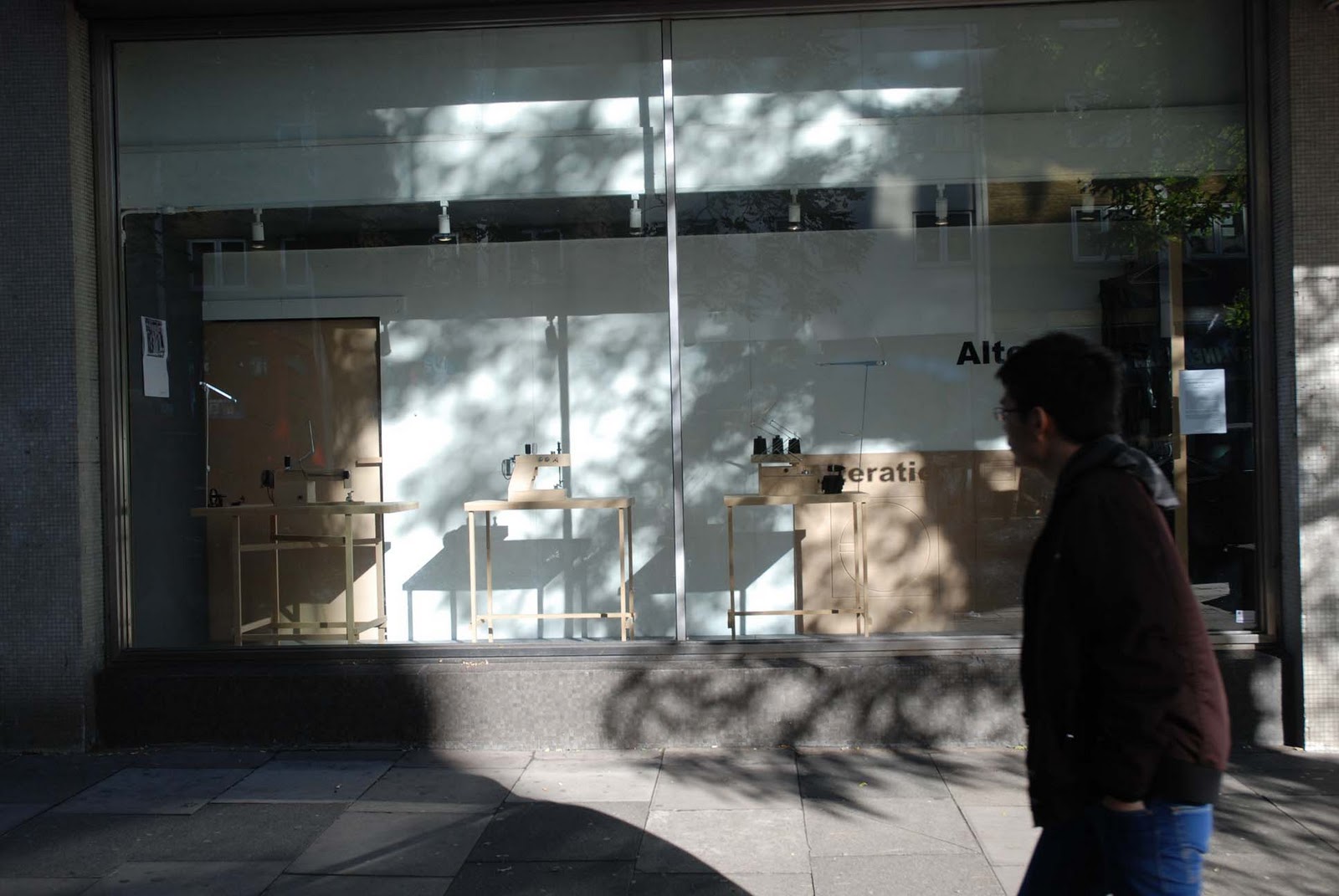
A Change of Perspective: Valentino Diego and his Alterations


When I spoke about connections, I had no idea how far this would take me in terms of artists' contacts and all the great projects that have followed. 

Ladies and Gentlemen, I give you D.V., aka Valentino Diego. A post from very long time ago gave an introduction to our MA Curating the Contemporary brand new, self managed, not credited and auto funded Window Project, affectionately nicknamed the MACC Relay.
The first of four projects opened on 13 October, in the middle of one of the craziest weeks for London's contemporary art scene - and for SybinQ Art Projects in particular - ever. 
I already knew Diego's great capability to build things. Still, I had no idea about his incredible visual talent, nor about his photographic memory. Working with him made me rediscover another notion that is not really attached to contemporary artists anymore since a very long time: being able to craft things, to create new objects with your hands, to bend the medium and give it a different meaning. 
In one word: craftsmanship.


Diego took plain MDF, some metallic bits and pieces, hangers, bin bags and transformed everything into an environment, a place with functioning objects in it. This function was given by the idea behind the installation: a fake alteration shop, a prop, trying to convince the passer-by of its authenticity. 
In the text I wrote for the display panel, I came up with the concept of the street window being the primary form of display: we look at these windows expectantly, because we're used to them offering us something we may - or may not - desire.

Once again, the intention here is to stop this process.
Every single object on display seems to shout Just stop, look at me, look at me closely, I am not what you assume I am. Don't assume: experience it. 

Yesterday it was de-installation day, and all these beautiful objects came back to be waste material. While I was carrying everything out of the space and stacking them in a safe place (I don't have the heart to just throw everything away, as the artist instructed me), I couldn't help to think: all this work, and none of this made to last. 


On my way back to the underground, I noticed a huge advertising board at London Met, made to cover the current works in progress to refurbish the studios. It reads: "See things from a different perspective".

What a coincidence.

Sunday, 19 September 2010

Designers, Artists and a touch of Red Sea

London's Design Festival 2010 is upon us. This sounds like a daunting sentence, but in fact it's just that there will be so many events scattered around town that you won't even know where to turn. Yesterday I gave it a start by going to an exhibition mixing together artists and designers in a former factory listed for demolition. In this difficult economic climate, pop-up shows in abandoned or empty spaces are thriving, giving creativity the chance to fill in the void and reinvigorating the old concept of philantrophy. I must confess that I am very fond of such spaces: their roughness, the mouldy walls, uneven floors and gigantic windows give a different flavor to exhibitions, dragging them closer to the viewer, lowering down the "sacrality" of the space to a much more relaxed experience. Of course the artworks are still for sale, but it won't be only about that.

Sure enough, when I popped into the huge room all I find is groups of friends, beer in hand, chatting among each other. The works occupied the space evenly, from objects like customizable squared ceramic vases or an interesting table lamp that is actually a lamp-table to a large size picture on the wall and a sculpture made of wood bark appearing behind a mirror. The boundary between design and art object in this show is indiscernible, because none of the design objects seem to aim at being functional. I guess the only difference is the interaction: you normally can't touch an artwork, whereas you'll definitely want to touch, for example, Alison Dunlop's corner mirror made of many leather gusset that you can open or close as you please, creating different patterns on the interactive surface.


I. Loved. It. Why? Because it becomes your playground, and your mark will be upon it until the next person decides to change it. It's democratic, ever-changing and not functional, as the reflecting surface doesn't really do the job. It's an artwork that you can touch and change.


Next door to all of this glittering and clattering, another show was there to be discovered, announced just by a timid red candle.
Inside: myself, two artists, and another guy. In terms of affluence, it reminded me of my openings. Maybe attracted by the empathy, one of the artist immediately approached me. She was elegantly wrapped in a white cloth which had the same consistency of sails and wears dizzy high black heels, her hair tied up and hanging down scruffily, making her look like an underwater mangrove:

"How did you hear about this show?"
"Er...I am coming from the opening next door..." No offence, we both are foreigners who go straight to the point. The Importance of Not Being Earnest rule doesn't apply here.

She handed over some literature with scatter sentences about the need to "invest physically" and "relating clothing to circumstances / creating history / sharing its process". I learned that the artist Arunas Survila "has gotten involved", but the girl's name was nowhere to be seen and I soon forget it.

She informed me that there will be a performance, later, and showed me some clothes, hanging from ropes, that were left soaking in the Red Sea. The process was filmed and the fabric felt heavy and rough under my fingertips.
That had the power of a Proustian madeleine: suddenly, the long gone days at sea in a summer that unfairly lasted too short came back to me, the salt flavour in my mouth, the thickness of the sea water permeating and beating my days.

Some other clothes had a less nice fate: they were filled in with raw meat and left to be tore by stray dogs: "There are a lot of stray dogs in Russia, you see?" she told me. Well, I think, I guess they had the time of their lives thanks to her. So why she did that? "To create patterns on the clothes", is the answer. Also, she wasn't very happy about the result because the holes are in far too precise points, they seem almost industrial. She described the whole process as "very hard and disgusting', then gave a good sniff right on the dried blood: "You can still feel it."

But I still don't get it.
Don't get me wrong, Mangrove, I did like your installations and think they had some potential. Some thoughts and sensations are still stirring if I think about it. But honestly, next time, just find yourself a curator. As I should find myself a PR.


Sunday, 5 September 2010

The Memory of a Goldfish

I have liken to this phrase a loooooong time ago.

High school, the 90s. I was in a funny mood and thought to remind a guy I barely knew that he had forgotten about my birthday. Instead of snorting, the guy thought of a funnier way of having me on a bit and started hugging me, moaning: "Oh my God, you're SO right, I am SO SO sorry...I have the memory of a goldfish!"

He doesn't know that this sentence is now my patented property, used and abused countless times. Especially because I do have the memory of a goldfish. Meaning: I forget stuff all the time (not the important stuff, though!). 
Here is a fresh, funny example.

Last night, I was in conversation on Skype with Silvia Iorio:

Si - So, did you like Stockholm?
sy - Very much!
Si - Did you go to Fancy Space Of Which I Don't Remember The Name Right Now?
sy - Er...no, I didn't know about it...but it must have been closed, everything was shut for the end of the summer...
Si - Ah, shame!
sy - But I did go to the Moderna Museet.
Si - Oh, did you?
sy - Yeah, the permanent collection is very interesting. For example, I saw a video by an artist I didn't know, Martha Rosler...
Si - (makes a face)
sy - What?
Si - But it's the same artist!
sy - The same artist of what?
Si - Come on, don't you remember? I have brought you an artwork from Basel* by Martha Rosler!
sy - (blushing from head to toe) Oh...ah...is it...her?
Si - YES! (laughs)
sy - Er...really? Let me just check...
Si - (continues laughing)
sy - (fidgets with a rather torn picture representing three egg-shape forms in various colours. Checks the name behind. Capitulates) Ah, OK...didn't make the connection...
Si - (affectionately) You are terrible!
sy - Sorry...I have the memory of a goldfish.


> Writing down every single name of the artists you don't know and then forgetting them anyway: Curator's Stuff.

* We are talking about ART PARCOURS, organised this year at 41 Art Basel. Martha Rosler presented Fair Trade Garage Sale at the Museum der Kulturen: inspired from the American "garage sale", where one person's junk is another person's treasure, everything presented by the artist was for sale and the prices could be negotiated.

Curator's Stuff - Stockholm

Colder, cosier, and more expensive.

That is how I would describe Stockholm at the first impact, compared to jolly old London. I have just spent five days there, setting foot in Sweden for the first time to accompany a certain Cardiologist to the annual ESC Congress. Work for him, leisure for me: I have discovered that wandering around on your own in a new city is not the end of the world after all*. But it is very, very harmful for your pockets, because you're more inclined to give in to the impulse buy.

Five days are not enough to understand another culture of course, but I could try and sum it up this way:

The Swedish like: 
- Tall and narrow spiral staircases (pictured);
- Walking on the cycling path;
- Keeping bar's customers in line (see below).


The Swedish don't like:
- To give directions;
- To use the word "pineapple" instead of "ananas";
- To apologise when they bump into someone. Unless "grunt" meant "sorry".

Speaking of cycling paths, I must admit that I have started to rate my liking or not of a city based a bit too much on how good the bikes facilities are. This way, poor Rome would occupy the last place on the chart.
In Stockholm there is the same bike scheme just launched in London, with the fundamental difference of being able to keep the bike for free for three hours, rather than just half an hour.
I guess the Stockholmers made this very clever reasoning: "There's no way a tourist will get the names of our streets straight: we must allow plenty of time for them to get lost, find their bearings, and try again." I would like to thank them for having thought of me. On two wheels, the whole city is at hand: the paths along the canals, with highways running right above your head, are very enjoyable, and even the worst sense of orientation has a chance of redemption.

Another thing I very much liked about Stockholm: I didn't get a Huh? as a reply when I said that I am a Curator.

For my visit, the main targets were, of course, museums and galleries. Let me say that the end of August is not really the best time for this, because most of the places are closed and busy preparing for the autumn season, like for example Magasin 3: THIS FALL A GREAT STORY BEGINS a lot of banners shouted around town. Shame I will only be able to follow their promising next show through the Internet.

Luckily, not only the Moderna Museet was open, but it had on the Ed Ruscha retrospective that I had missed when it was at the Hayward Gallery here in London. That's what made me think of the "Curator's Stuff": sometimes, on Facebook and in my language, I see some square messages appearing as links on people's status. For example: "Being happy about having put the eyeliner perfectly on one eye, forgetting that the same thing should happen on the other: Women's Stuff". Or another one, more specific for working roles: "To separate form from content: Designer's Stuff". And so on and so forth. There are the most embarrassing (and truthful!) features for Psychologists, Architects, Teachers, Singles, Students, Art Historians...but no Curators.
I can give you one now, the first of a long series in this blog:

> Missing a traveling exhibition in your hometown and going to see it in another country: Curator's Stuff.


The Moderna Museet knew its golden age in 1960 with the curator Pontus Hulten, who managed to create a bridge between Europe and America by hosting shows of young American painters, among which were Jasper Jones and Robert Rauschenberg. Later, in the 90s, he started to emphasise the direct participation of the audience to the shows by proposing broader themes like poetry or utopian societies.

> Spending four hours in a Museum, making sure you have read all the labels: Curator's Stuff.

The permanent collection has some real flagships, divided in chronological periods: for example, the Cow Wallpaper by Andy Warhol, in which the museum was wrapped up in 1968, Martha Rosler's Semiotics of the Kitchen, 1975 (embedded below: I found it illuminating) and a Surrealist woman I didn't know anything of: Dorothea Tanning.

> Getting annoyed because you have confused Eva Hesse with a relatively unknown Swedish artist: Curator's Stuff.

The day after was a Monday, vacation day for most of the exhibition spaces. The only arty place open was the Thielska Galleriet, at the far end of Djurgarden. No bike station was available down there, so my unfortunate travel companion (another lonely doctor's wife) and I parked the penny-farthing and embarked in what we thought was a 20 minutes walk to reach the spot. After 45 minutes, a rain shower, countryside landscapes and some moaning, we arrived at this lovely house from the beginning of XX century, owned by the banker Thiel, art patron of his times. The collection comprises remarkable examples of Nordic art from late XIX and beginning of XX century, not to mention the outstanding furniture and the poignant, decadent atmosphere of the place.


> Walking 4 kilometers to get to a remote public gallery just to see Edvard Munch's paintings in the flesh: Curator's Stuff.

* I am Italian: compulsive sociability is deeply rooted in my genes. We hate eating on our own, traveling on our own, and even talking on our own.


Thursday, 26 August 2010

Window of Opportunity

Duccio Di Buoninsegna, Flagellation, 1308ca
Tempera on wood panel,
Museo dell' Opera del Duomo, Siena, Italy

Definition of "Window of opportunity" from an on-line source:
Idioms: Fig. a brief time period in which an opportunity exists.
What we see in this image is what our friend Duccio must have thought to be an incredible breakthrough in the much sought-after use of perspective in painting at that time. Like Giotto, Duccio was a pupil of Cimabue, the undisputed pioneer of the creation of the third dimension according to the biographer and first art historian Giorgio Vasari.

It was the XIV century in Italy, and religious painting was greatly influenced by Byzantine examples in which flat, uncanny figures of Madonnas with Baby floated about with no chiaroscuro in their clothes nor any shadow on the ground. In short: no sign of humanity was to be recognised in such icons representing the Divine, and the Italians did what they do best: copying, and re-elaborating in better quality. Little by little, the use of perspective opened a window of opportunities in figurative representation, bringing Gods and Saints back to reality, down from the heavenly sphere to mingle with the common people who, in turn, felt closer to them.

Now, this image nowadays makes us smile a little, because we can see that something is wrong with it: Pilate is neither inside nor outside, with his arm outstretching in front of the column; we can tell the construction of the "box" hosting the scene is weird, whereas the layers of the attending people land on no floor, like cards laid on a table. Despite Duccio's efforts, the image is still flat; it would have taken at least another century to get, for example, to this.

After all this I hope interesting stuff, you may be wondering why I have chosen this particular image and am posting this particular post. First of all, Habda was inspired by the image - during one of her visits to the National Gallery - which can be used as a tool leading to develop free interpretations of the concept  "wrong perspective". This triggered a whole series of thoughts that the other curators and I are going to develop into shows, in another window, starting at the end of September. 

Apparently, windows really are receptacles of opportunities at the moment. 

Regarding the wrong perspective, let me tell you something more: it's not that Duccio wasn't aware of the wrongness of his image; he deliberately chose to emphasize Pilate's death sentence through the gesture, even if this literally had to come out of the scene. In my opinion, this makes a huge conceptual difference. On the basis of this, what would be the wrong perspective, his or ours?

Saturday, 21 August 2010

Ausstellungsmacher

Don't worry, I am not insulting anyone in another language.
Especially in German, which is something I don't even have a smattering of. I can pronounce Oranienstraße or Ja correctly, but that would be all.


According to Harald Szeemann, the Ausstellungsmacher (translated, the vulgar "Exhibition Organiser" before the advent of the fancy word "Curator") is:

- Administrator
- Amateur
- Author of Introductions
- Librarian
- Manager and Accountant
- Animator
- Conservator
- Financier
- Diplomat

Just a German word, to summing it up so well.