Showing posts with label Connections. Show all posts

Wednesday, 7 December 2011

The #leaveamessage Day: Roads of the Unexpected

The Laws of Destiny and Chance are those that cannot be classified.

Randomness is something very much cherished in art: from the Surrealist's automatic painting, going through Pollock's famous drippings to mention what once Picasso is told to have said when asked about how his Blue Period developed: 'I ran out of other colours', he replied.
And just liked it so much as to carry on.

By the way, this is not a post about found objects, but found messages. Has it ever occurred to you to find an unexpected nice message in an unexpected place? I remember the 'secret admirer' when I was in Primary School. Love messages started to pop up in my pencil case or folded in the sandwich wrapping, and I perfectly knew it was some female classmates just taking the piss. I could match handwritings all right, even at eight. However, it was nice just to believe it, if only for a split second.
Even most interesting than this are those messages that perhaps weren't meant for us, but we find anyway. A lost letter. A post-it note stolen by the wind. A torn bit of words floating in the river.
A private message sent on Facebook to that not-so-famous-actor on his 40th birthday, just to let him know that you spared a thought for him and he's still gorgeous and you had a massive crush on him when you were eight and possibly never quite shook it. (embarassed cough)

It's like a treasure hunt, but you don't have to look for a treasure and you have no map. That something as simple as kind words is finding a way to come to you. Click.

Now you should take a further click, and read how come that this idea of the #leaveamessage day occurred to Wonderland. Just scroll down for the English version when you reach the post, and sign up if you feel like spreading some happy thoughts and cheers in the run up - or count down - to Christmas!

SAVE THE DATE: #leaveamessage day is Wednesday 14 December !

I like the idea of one of you, random readers, finding one of my messages. None of the two of us will never know, perhaps, but for a moment our distant lives would touch, and then turn back to normal.
Hopefully with a smile on our faces!


Tuesday, 18 October 2011

The Underground Diaries: Random

Colours and friendly faces.
Everyone comes to London for the Frieze Art Fair. If Rome is caput mundi, London is caput ARTE.


9 October 2011: Flower Power - Jubilee Line, London

Frieze's Week: Artists and Curators - Hammersmith & City Line, London

Frieze's Week: Artists and Curators - Hammersmith & City Line, London
        

Monday, 17 October 2011

A Two-Times Exhibition: Silvia Iorio's Odyssey 2010 | Odisseia 2011

Perhaps some of you remember this post.
It doesn't say much, it is just the Press Release of the first show my colleagues and I curated as part of our  MA in Curating the Contemporary at the London Metropolitan University, which we successfully completed this year. Instead, that simple post - and show, is the start of something unique.
Something that needs to be read through the lines to be caught and understood.


But let's proceed in an orderly fashion.
When we involved artist Silvia Iorio in this show, she conceived an artwork, Odyssey, which was to be further developed in the upcoming year. The challenge presented to her to go beyond a clearly defined site, and pierce the walls of a space, was met with the idea of creating a two-times exhibition.
Odyssey is a panel with 160 coloured switches "that people were invited to activate during the opening night, on the12th of May. No light would go off at the same time, though: the artist decided to stretch this event in Time – and Space – by having the Light travelling through the Universe for One Light Year. An unconceivable distance for a human being, as it is the speed at which the Light travels (...)
Through Silvia Iorio's eyes, the journey of Odyssey’s Light reached even the most remote and unknown points of the Universe. The various stages of the journey would have been impossible to document had it not been for the experiences of the people attached to them. As part of the project, the artist created the conditions for those who participated to Odyssey to re-interact with the artwork: every 12th of the month, for 12 months, they received an email with questions about what they were doing at a precise time, what they were thinking, and if their mind and body were “connected”. How many times are we caught in the middle of doing something, but our mind is elsewhere? Yet, mind and body are closely interconnected, like the switch and the light. Through the answers she received and collected, Silvia Iorio was expanding the concept of dislocation and taking it onto new levels."*


Silvia Iorio, Odyssey, 2010, One hundred and sixty switches, MDF, enamel, aluminium and wood, 224 x 118 cm


Now, what happened after a year, namely this year 2011?
The first thing to say would be that artist and curator, too, were dislocated. The artist was in Berlin, the curator in London. The two of them were disjointed, their dialogue possible only through modern technology. As the dialogue between Odyssey and its twin work Odisseia, everything seemed hard and impossible: how can it be that two different events, happening at a different time and place, are brought together and re-connected in a solo show? Initial ideas were discarded and a more complex outcome took form, the barriers of space and time acting as incentives. It couldn't have been just the same panel, with 160 lamp bulbs bearing the same colour as the switches, and lighting up in the same sequence they were activated one year before. Very predictable.
But Silvia Iorio is an artist of many resources, and surprises, as sometimes Science is. 
Therefore, the Light manifested itself through imaginary Celestial Maps, from where unknown stars, which are lost in the vastness of Universe, shine for real for the eyes of those who can see them. 
They shine for the eyes of those who see the created connections. Light came back to Earth, and earth made its appearance in the gallery space. 21 people among many who activated the switches, one year before, were the most regular contributors in answering Silvia's question about their whereabouts. 
Their coloured experiences materialised in the form of 21 light terminals, and here the circle clicks, and closes.


And to think that everything happened by simply turning on a switch!
On September 22, 2011, the exhibition Silvia Iorio Odyssey 2010 | Odisseia 2011, was successfully concluded.


Silvia Iorio - Odisseia 2011, Installation view


Odisseia 2011 - Celestial Map, detail, dimensions variable 


As I told Silvia, I find her watercolours nearly moving.
To imagine corners of Universe no one will probably ever see, but that she was able to evoke thanks to the inspiration of Light travel and people's experience, is a gift. 
The experience of the casual viewer included, of course, the fact that seeing is believing.


P.S.: I am happy to mention another show that successfully featured the Celestial Maps, which are having a great and well deserved success: Silvia Iorio, Age of Time. Edge of Space, part of the ongoing show series Rendez Vouz Mit Kunst at the Restaurant Diekmann in Berlin. The show, curated by Isabelle Meiffert, was on until the 8th of September. An installation view is below and more pictures can be found here.


_________________
(*) Extract from the catalogue's text. You can read the full version on the Galerie Mario Iannelli's website.

Thursday, 29 September 2011

New Art Criticism_01_December 2008

New Art Criticism is no longer on-line, therefore I thought to copy and paste my contributions to the former website here. It is mostly exhibitions reviews and I hope you will enjoy the reading!


PLAYING GAMES WITH LANGUAGE: KATE STREET SOLO SHOW AT NETTIE HORN

Wandering and rummaging about which show was worth reviewing in this cold winter, I must admit that the only spotting of the Nettie Horn website made me decide to come and see this one: the small, pixel-made images were showing drawings beautifully made, with what I call a superhuman skill to make the pencil strokes disappear in a foggy, perfect sfumato.

It looked like a plant in a drawing you might well see in a Victorian botanical etching, however the orchid spreads from a dissected heart, whilst little bird’s skulls grow within the flower’s place; this can be considered as being very odd. Why are artists so obsessed with death now, I thought. Then, recalling the old still lives, I corrected myself because they’ve actually always been.

However, what sparked my curiosity were the use of the birds. As soon as I entered the gallery space, I was surprised to find another kind of artwork I did not know about: three sculptures, or rather assemblages, in the form of a funeral wreath. Flowers, of course, were neatly arranged in a circle and in the form of a heart shape. Again here and there we have “intruders” such as human hands and stuffed birds peeping, holding objects such as broken spectacles, trinkets and even chocolate cookies, whose icing drips down the hand in perfectly frozen drops.

I just stare, realizing that I have to do with a fairly Queen of the Composition: nothing is left to chance, nothing is random. A painstaking work made of intricately crafted components. In another sculpture, two crows seem to be stuck on a black flower wreath invaded by busy bees, their honey leaking all over like viscous glue. The bees, birds and hands should ring some bell now. It is not only about death and a strange obsession with taxidermy, I can feel there is something else those works are trying to say. But for someone like me, oblivious of typical English language expressions, it is quite difficult to get hold of the hidden meaning without obtaining some clarification.

I learned from Marie Favier, curator of the show with Director Danielle Horn, that a “bird in the hand is worth two in the bush”. Excuse me? Ah, that is it…sexual meaning! We now enter the realm of language and its different expressions, ranging from one culture to another. Of course, the bees, the pollination…sex explained to children. The use of the orchid in the drawings evokes the ancient Greek belief that this plant sprung from the split semen of mating animals. There are then the skulls, Love and Death. Eros et Thanathos, no wonder Kate Street’s series of work is called “Little Death”, originating from the French term for orgasm “petite mort”.

We could go on for ages: Street uses words, proverbs and mythologies as a starting point to create sculptures and drawings tinged with a tongue-in-cheek approach to language. It is always interesting to see a young promising artist using something as simple as her own native language and turning it in something so complicated; imagery. Discomforted ones perhaps, which forces the individual to try and subvert the typical idea of romance into something far more intricate, perhaps beyond the usual classifications. It is familiar, yet extraneous at the same time. Those sculptures could seem an absurd baroque-style charade because sometimes that is what love longing can be. When desire is wasted, all is left is just a deep, aching sense of loss. How sad, simple and essential at the same time, though. If you are a fan of semantics and of the honourable art of cultural imagery, you will love Street’s work. Also, if you would like to see some not-too-cryptic contemporary art, you should definitely hit this show, which runs until the 21st of December.


End note: this first visit brought a further collaboration with Kate and a video work was proudly presented by me in a public museum, here. 

Saturday, 30 October 2010

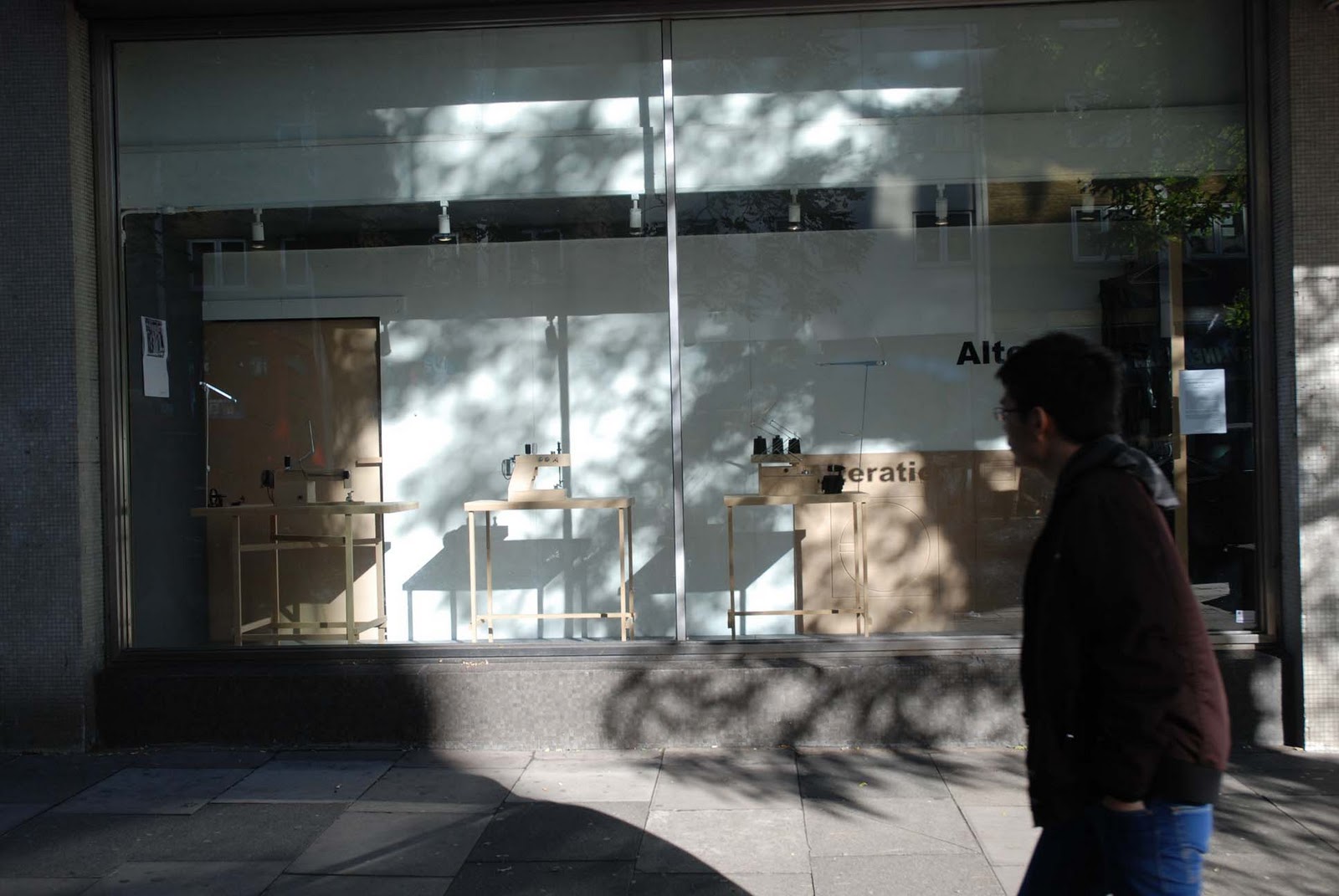
A Change of Perspective: Valentino Diego and his Alterations


When I spoke about connections, I had no idea how far this would take me in terms of artists' contacts and all the great projects that have followed. 

Ladies and Gentlemen, I give you D.V., aka Valentino Diego. A post from very long time ago gave an introduction to our MA Curating the Contemporary brand new, self managed, not credited and auto funded Window Project, affectionately nicknamed the MACC Relay.
The first of four projects opened on 13 October, in the middle of one of the craziest weeks for London's contemporary art scene - and for SybinQ Art Projects in particular - ever. 
I already knew Diego's great capability to build things. Still, I had no idea about his incredible visual talent, nor about his photographic memory. Working with him made me rediscover another notion that is not really attached to contemporary artists anymore since a very long time: being able to craft things, to create new objects with your hands, to bend the medium and give it a different meaning. 
In one word: craftsmanship.


Diego took plain MDF, some metallic bits and pieces, hangers, bin bags and transformed everything into an environment, a place with functioning objects in it. This function was given by the idea behind the installation: a fake alteration shop, a prop, trying to convince the passer-by of its authenticity. 
In the text I wrote for the display panel, I came up with the concept of the street window being the primary form of display: we look at these windows expectantly, because we're used to them offering us something we may - or may not - desire.

Once again, the intention here is to stop this process.
Every single object on display seems to shout Just stop, look at me, look at me closely, I am not what you assume I am. Don't assume: experience it. 

Yesterday it was de-installation day, and all these beautiful objects came back to be waste material. While I was carrying everything out of the space and stacking them in a safe place (I don't have the heart to just throw everything away, as the artist instructed me), I couldn't help to think: all this work, and none of this made to last. 


On my way back to the underground, I noticed a huge advertising board at London Met, made to cover the current works in progress to refurbish the studios. It reads: "See things from a different perspective".

What a coincidence.

Thursday, 21 October 2010

Frieze 2010 in ten minutes


New Blog, new life.
Someone tells me it does look a bit too serious, but I am confident I will expand my blog design knowledge in the forthcoming weeks, and maybe something will be done on this regard. 
However, why shouldn't a curator be serious? 

We've just left Frieze's week behind us and I am slowly switching from the frenzy of organising stuff and meeting people to the act of looking intensely at the computer screen, try to work out what to do next. To put myself together, I am just making up deadlines: I have to finish this post by six this afternoon. 

The video I have put above was filmed and edited by Italian journalist Riccardo Stagliano' with an iPhone, the new frontier of communication. The title reads: "The Art of Selling Art".
The Frieze Art Fair really reins upon anything happening in October: the whole art world revolves around it and, although other galleries and exhibition spaces try to organise parallel events, it is likely they'll end up with just a bunch of visitors who, by the way, came for the fair and just happened to stroll by. Not even the new Sunday Fair, of which I heard very positive comments - especially about the free entrance -, or the much anticipated prints fair Multiplied at Christie's, could claim the same amount of visitors. My approach to the fair is completely different from that of any other visitor or journalist: we can call it the Nerdy Approach. This year, I have set a personal record of time spent visiting the fair: 10 minutes. 

> Popping in at an Art Fair at 5:50 pm thinking that it will definitely close at 7 whereas it definitely closes at 6: Curator's Stuff.

This is nothing of a performative nature, just the grim reality of not being able to go because I am usually working elsewhere: after all, I am part of the lovely art world too. The first time I went to Frieze, in 2005, I had the privilege to go to the private view. All I remember is struggling to see something whilst I was literally dragged towards the drinks area by the crowd. In the opposite direction, a flock of paparazzi was running after George Michael. After a while, I thought I was a bit drunk when I saw a portrait by Julian Opie winking at me. Maximum time spent there: one hour. 

Second time I went, I don't even remember the year. Must have been 2008. First proper visit, I think I have spent at least two hours in there, and the only memory I recall is bumping into Valentino and into a friend of mine: we were interns together for a famous gallery; now she was a gallery director and I was... well, just back to London and starting it all over again. Artworks taken in: zero. 

Last year, I think I made it for at least half an hour: I cycled from work, hung a press pass on my neck and made my triumphal stroll through the aisles. Said hi to a couple of people and exchange glances with others I know but couldn't greet because they were busy talking with clients. Art fairs have a very peculiar language, or code, that once cracked is very interesting to analyse. Artworks taken in: maybe just one; a large tree sprouting out from a wooden board floor. Artist's or gallery's name: uncovered.

Arriving at my ten minutes spent at this year's fair, there isn't much I can say: I literally crossed it running, trying to dodge the invigilators clearing people up and realising with surprise that it didn't seem much different from last year's one. It's like time is stuck, in that place. History repeating. Just the realm of sales, where art shines like tempting jewelry from its shop window, and dealers can't do nothing but pushing out the goods. It's a place where the young outsiders can only wish to understand the mechanisms behind. 

It's 6:02 and I don't think I have finished this post. After having delivered three shows in two days, all on time, for once I am going to be late.

Wednesday, 5 May 2010

The Odyssey and other journeys

We are a week away from the opening.

When I think about how quick all that time passed, I can go nuts. From now on, I will commit myself and put one post per day, just to keep everyone up to date. Thank you for following us so far.

Now, just before collapsing on the bed, let's talk about the Odyssey. 
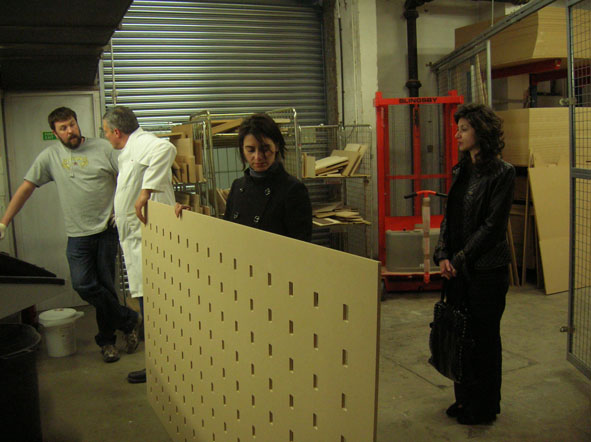
I am referring to Silvia's work title, which is the product of how the piece was born and why. I am not going to tell you all about it at once, though...better coming to the show to appreciate it in full! Today, we experienced the actual making of and saw it unfold and live before our eyes, at least in pieces. A big THANK YOU to the technicians at London Met wood workshop, Stuart and Jennyve in particular, for all their help today: we couldn't have made it without you guys and your patience. If you remember this post, you'll know now that we found a way to have this incredible piece on show.


When I left Silvia dealing with saws and messy measurements and entered our office, I was delighted to find Nathalie's work delivered: two collages, a big and a small one, very different from each other and therefore absolutely interesting. One in fact looks like a proper environment, almost another space with round elements floating in it regardless of perspective or gravity rules. The first word that came to my mind was: pop. And then, equilibrium. Peace.


Francesca is working on the screen for the projection of Guszstav and Katja's video. Today the built frame was delivered and we also have the black out material. The idea is, for the screen, to be perpendicular to the wall, like a floating canvas and work like a door, with hinges on the wall that allow it to be open or close, according to necessities.
We mustn't forget that Unit 2 will host also the talk and performances by, respectively, Cesare and Sophie, therefore we will need space. Literally. There's always a negotiation with the space.

We sorted out who's delivering what work and when for this and next week, and learned that Dylan is going neon. At the beginning I misunderstood and imagined a structure made of light, whereas what Habs was talking about is the colour of the structure. This activated Silvia and an interaction between artists begun: which colours shall she paint her switches in order not to clash with neon orange?
We'll know the answer to this question quite soon-ish.

Tuesday, 13 April 2010

Habemus Nomen


Try to imagine what it takes to find a name for a show that has such a broad and open concept as ours.

Normally a show would be named after:


1. An artwork or artist. Even in group shows. Like, for example, I am not here. An Exhibition without Francis Alÿs ;

2. A concept. But naming a show "The Space" is like calling a Chihuahua "Hercules";

3. A complete non-sense. The public will love it. Like when you go and see a show about needle-works called The Unbearable Lightness of Being. No, unfortunately this show isn't on yet, I've just made it up. If I have to improve my jokes please let me know.

So, let's put up a little scenario, shall we? Let's make it like X-Factor.
Gala Night. Just three contestants left. You can cut the excitement in the air with a knife. 

Ladies and Gentleman, for the final evening of Who Wants to Be a Show Title, we have...and then a figure, not yet illuminated by spots, appears in the dark just next to the curtain. He seem not to be steady on his feet and he looks a bit like...Willem. De Kooning.

...Slippery Glimpses! The Presenter announces, and the light goes on. The public claps in a very educated way. Slippery Glimpses nods politely in their direction.

...and then, ladies and gentleman, straight from Borges' universe (a place far, far away), we have...Aleph! From behind a curtain emerges a lady with a long, sparkling black dress with white spots; she seems annoyed: "Emh, excuse me" she says. The Presenter looks startled: "It's The Aleph, actually. I am a point in the space that contains all other points. Anyone who gazes into me can see everything in the Universe from every angle simultaneously, without distortion, overlapping or confusion. And I would like to say hi to my mum. HI MUM!" 
Yes, err...thank you THE Aleph, very well, please take your position. There we go...and finally, ladies and gentleman, we have...

The curtains suddenly opens. It is a bit unfair to the other contestants, who frown. On the other side, there is...nothing. The expectant drums sound suddenly falls and the embarrassing silence is replaced by the public's gasps.
Sorry, we're...the Presenter begins in an apologetic tone. "Sorry, I am here!" A voice calls from the floor. Slippery Glimpses bends down and picks up what seems like a door sign. The Aleph looks horrified.

He reads aloud: "Sorry, We Are Open." 
"Yeah, that's me!" The signs reply. The Presenter makes up for the impasse.
Yes ladies and gentleman, that's him! And now that we have all our final contestants gathered here, I will finally announce the name of the winner...


And let the curtains close here, because I am sure you understood who the winner is.
Well done Will!

Friday, 2 April 2010

How about some advice?

I have read with great amusement this recommendations to a budding curator by the self confessed newspaper man Augustine Zenakos, who in turn was suggested to us by the curator Tom Morton. I couldn't resist but leaving some personal comments.

Read a lot of post-structuralism, preferably in the form of quotations you can find in catalogue essays. Quote them in turn, profusely, making sure their relationship to any actual artwork remains obscure.

Whenever I see the word "post-structuralism", I just turn the page over.

No studying anything before the 1960s is allowed. Learn all your history through contemporary art theory.

I tried that, but my heart belongs with the idea that history, all history, is necessary to do a good job.

Never say you are anything more than a facilitator for artists. If inadvertently you do, and you momentarily appear like having anything remotely resembling a vision or, worse, an agenda, cover it up quickly with a phrase like “curators have to stand firm against the voracity of the market”.

Yes, Master.

Be as immaterial as possible, be a ghost. Support everything anti-spectacular and insubstantial. When asked to describe it, use words like interventional, process-based, archaeological, investigative. If challenged with something like the inability of others to see the point, call them antiquated and formalist and declare the work of art to be changing.

You forgot to include "taxonomy" in your list, Master.

Praise the local, but in abstract terms. Make sure that you choose a local thing that does not require any local knowledge to be understood. If you can’t find something suitably local where you are, pick a Mexican or a Lithuanian one. When faced with a situation that is truly local, dismiss it as nationalist, and continue.

But this will cut any potential fund out, Master.

Be against state-run cultural policies, as well as private enterprise. Declare your support for small autonomous zones of collaboration. When asked about their funding, don’t dwell too much: this is not about money.

And the fact that it is never about money makes the curator zone off limits for those who can't afford it, which is a shame.

Be for independent organizations, but when faced with one, call it cliquey and turn away. There is nothing there for the taking, anyway.

Er...Yes, Master.

Always acknowledge the public. Say that all this is being done for their benefit, because contemporary art is for everyone. Then, blame lack of funding, public support, etc. If someone appears to be practical about these things, call them a behind-the-scenes-mover-and-shaker and state that you are not interested in authoritarian structure.

Wow, I never thought to actually be such a complicated thing. I just thought I was practical.

You’ll do fine.

Thank you, Master.

And now, let's close the little distraction-from-the-more-important-task-of-writing-the-damn-catalogue-text-for-our-show-post and go back to work.

Saturday, 20 March 2010

First Meeting: where we stand


I know, it is a bit too late for this since we had our first meeting...hum...two weeks ago now! But, as you might have perceived by now, I do like blogging and would like this experience to remain somewhere, even lost in the internet's mesh.

It was the 10th March, a grey afternoon, when this show finally took on some kind of definitive form, which now needs to be adjusted, polished or even reviewed. We went to The Big Chill Bar on Brick Lane, perfect if you are on a tight budget but nonetheless need something to eat to get the brain spinning. Maybe we had no idea that we were to spend all the afternoon there. The first point of the meeting was: which artists do we want and why? And there, our coherence of selection finally showed: five different heads came up with eight/nine very different artists who, thought, share similar concerns about the identity of the space we are trying so hard to nail down.

We started considering Unit 2's space in particular as active/inactive: show/no show; like a brain in a body and its various connections, a mental space. This clicked with Sophie Vent's practice of mapping: a map is a type of space, a way of setting boundaries and crossing them. She will identify a map of the endorphin when it's released in the body and then translate it to a dance with the collaboration of a choreograph. Will thinks her idea to have the choreography danced by children and filmed on video is great. Going on on Unit 2, we already said that the access is restricted: the gates will be opened during the opening, but then only people with budget will be admitted in. So one question might be: who is actually going to see the show? That's when Russel Chater steps in: he is "seeking to explore spaces and states that are in between or beyond". He will cover the window with a white element used to cover derelict spaces, blocking the view from outside. During the opening, people will be invited to draw or write on it, leaving a trace on this temporary space and, most important, allowing people from the street to peek into the gaps and take a glimpse of the space. Habda also proposed other two artists, Charlotte Bracegirdle (whose practice is already explained here) and Nathalie Guinamard: with her, we enter the realm of displacement; she works with collage, selecting unaltered sections of interiors and exteriors and seeing how they work in juxtaposition: spaces in between become even more important than the visible space itself; perhaps she will work on what she'll see in-between Unit 2, and we'll hopefully discover new connotations.

Although her work will certainly be the most complicated to install, Silvia Iorio is still up with her switches installation, described here. The lamp bulbs will be all outside Unit 2 and, apart from some that we'll try to keep visible, when someone presses the button imagination will take the lead to identify where a lamp bulb is actually going on and off. Light will cross the space's boundaries, showing it for what actually is: infinite. The space as interface, meaning point of interaction, is represented by the video artists Katja Pratschke and Guszstav Hamos, whom Francesca met at the Tate. It may seem that the body and its connections are the protagonists again, but in this case it is the space of the video as a medium that is questioned through the display of still and moving images. Last but not least, Martina Geccelli, sniffed out by Clementina. A German artist with an Italian name, Martina works with photography in connection with architectural and sculptural conditions. She shoots everyday, banal objects like books or cardboard boxes to show their often hidden relationship. We all liked very much the picture of two cardboard boxes arranged upside-down, holding up in a precarious balance enhanced by their almost touching flaps. Another kind of space, defined by its limitations, the physical outlines and that in between.

Wow. A lot of concepts have been dished out here, but personally I see no discrepancy between our artists. I see something that has just started to build up. Now we would need someone authoritative, a dead or alive critic, with a strong "space" concept to place at the beginning of the critical text, in order to convince us all that this is the right track.
Isn't it?

Thursday, 18 March 2010

The Visit


On Wednesday, we went to meet a very important person and contemporary art collector here in London. The encounter took place in the outstanding Winfield House, in Regents Park, where the American flag waves.

This might just give the right tip about whom we had the privilege to shake hands with: Ambassador Marjorie Susman. Skipping over the details about how in the world we ended up drinking tea and eating brownies with her, our visit was focused on the exploration of the house and the art collection, which the Ambassador graciously opened to the public. The house's interiors, those of an historical residence where many other Ambassadors lived, are enriched by a contained Neoclassical taste with matching furnishings, in some cases hosting sculptures by, for example Claes Oldenburg or the contemporary David Smith. To keep company with the traditional portrait of President Washington there is la crème de la crème of American Art from the 50s, when Abstract Painting arose. The Rothko up there is just a small example, then we found a red Ad Reinhardt's canvas perfectly at ease in a room with green, flowery wallpaper on the walls, or a Lichtenstein's mirror in a yellow room. The deep equilibrium of that was disconcerting, as you'd normally see such painting in a white cube, with the proper light and the proper aura.

It was nice to look at each other's faces while we were been taken around, dumbfounded. Not only were we taking in the grandness of the place, and the meaning of an Ambassador's role, which after all includes the transmission of a Country's culture; we were seeing landmark artworks in their natural context, that they were created for: a private home.
And how differently they looked, what a warm welcome they gave us, not from behind a protective plexiglass but within reach, illuminated by natural light, off the pedestals, human again.

The Ambassador also told us about her role as patron of the MCA - Museum of Contemporary Art in Chicago: a one-year long Curatorial Fellowship, which bears her name, is available; an opportunity to work closely with the museum's collection, with emphasis on the aspects of art history and research.

Now, this has nothing to do with the show, but it has to with the course we are part of. I think seeing private collections is an important experience, because it makes you perceive the artwork differently.

Thank you to the Whitechapel Gallery for this opportunity.


Friday, 5 March 2010

Black and White Berlin

Last week we went to Berlin with our tutor for a four days full immersion in the art scene.
It was really great. Berlin, which not all of us visited before, looked like a black and white photograph: the sky was grey and the streets covered in snow, salt, ice and dog's dung.
The presence of the war strikes you there like nowhere else: missing houses, bullet holes, silence and cranes everywhere. I had the sensation that Berlin never fully recovered from that, including the heavy heritage the war brought along.

But the art scene is something different: it is like East London in its golden days. Not spoiled yet, vibrant, affordable and with a definitely different attitude. We met curators and artists, and all were keen to talk to us open hearted about their different experiences, even if this required a good deal of chance and improvisation. In plain words, less academism and more generosity. A big, international artist community is operative in Berlin; I would have never imagined to catch up with some of my peers, totally by chance.

Of course, this brought new lymph to the show: we met Italian artists Silvia Iorio and Cesare Pietroiusti. Me, Clem and Fra went to Cesare's talk at the NGBK and found his dissertation about how he conceives the space truly inspiring. I will just quote one single sentence from that night, which in my opinion says it all:

"When I was eight, my family and my grandparents used to live next door to each other. Every night, I would go to bed at the same time and my Grandmother would knock from the other side of the wall, just to wish me goodnight. I then started to think about how I could reach the other side to go and see her whenever I wanted, and the most obvious way was to dig a hole in the wall. I would hide under my bed and work on it with an accomplice friend of mine. When my mother discovered it, she wasn't very happy. I have quoted this episode because I think that my whole artist career is an attempt to get to the other side of that wall, but I am still stuck in the middle."

Silvia is an old friend of mine, even from high school. Our paths always crossed since then, and always by chance. It was a pleasure to find her in Berlin. We shared a table at the traditional German restaurant Max & Moritz and got totally taken away by the description of her work. Science and art, in a charming mix. She told us about how she, herself, tried to defy space's boundaries by using light as a mean of communication. She created a work with colored switches connected to lamp bulbs which can be dislocated beyond the gallery space - in a building nearby, in another room, even in another area - and can be turn on or off, perhaps used to send a message. Space. On. Off. Something clicked here.